

MONDAY SALE! • EXTRA 10% OFF + FREE SHIPPING DEAL | CODE: MONDAY10
MONDAY SALE! • EXTRA 10% OFF + FREE SHIPPING DEAL | CODE: MONDAY10

Hang kitchen wall art on the walls furthest from the hob and sink. Keep at least 24 inches between any canvas and a heat source, and avoid the splash zone directly behind a cooktop entirely. Breakfast nooks, the wall above a bench seat and the run beside a doorway are the positions that work.
Every other room gives you a clear wall and a fixed viewing position. A kitchen gives you neither. Cabinets take the upper half of most walls, appliances take the lower half, and what remains is broken up by sockets, switches and a window.
Then there is the atmosphere. Cooking puts heat, steam and airborne grease into the room. Canvas prints use archival inks that resist fading, and they are stretched over a solid wooden inner frame, but no canvas is improved by sitting three feet above a frying pan. The honest approach is placement, not a promise about the material.
So the useful kitchen wall art ideas are the ones that work around the constraint rather than ignoring it. Everything below assumes you are hanging art in the parts of the kitchen where cooking is not happening.
Ranked from safest to riskiest:
Where you have a full wall, use the standard: center the piece 57 to 60 inches from the floor. Where you are working in the band between a worktop and the wall units, forget the standard entirely and center the piece in the gap you actually have. That gap is typically 18 inches, so a piece around 10 to 12 inches tall leaves an even margin above and below.
Above a table, measure from the table rather than the floor. Leave 8 to 10 inches between the tabletop and the bottom edge of the canvas, exactly as you would in a dining room.
The nook is the one place in a kitchen where somebody sits still. One larger canvas here earns more attention than five small ones scattered around the cooking area. Size it to roughly two thirds of the table width or two thirds of the bench width, whichever the piece sits above. Because people view it seated, hang it slightly lower than you would in a hallway, with the center nearer 57 inches than 60.

Kitchen art defaults to lemons and coffee cups. Still life wall art covers considerably more ground than that, and the pieces that hold up are the ones with a single subject and a dark or neutral ground rather than a busy arrangement. A still life also suits the kitchen because it reads instantly. You are walking past it with a pan in your hand, not studying it.
Two or three botanical prints in a row along a narrow wall give a kitchen structure without competing with the cabinetry. Keep them identical in size and 2 inches apart. Green reads as fresh against both white and wood units, and botanicals avoid the problem food imagery has of dating quickly.

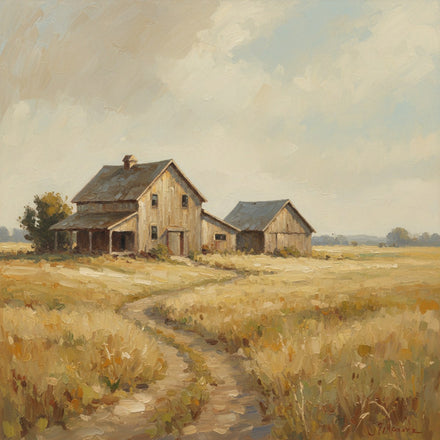
If your kitchen has shaker doors, wood worktops or a painted island, farmhouse wall decor sits naturally with it. Landscapes with barns, fields and open country carry the same visual language as the units. The trap is going too literal with signs and slogans, which age faster than imagery does.
Most kitchens have one wall doing nothing. It is usually opposite the run of cabinets and it is usually the wall you stare at while washing up. A single large canvas there, sized to about two thirds of the wall's usable width, does more for the room than anything you can fit between the wall units. Browse kitchen wall decor for subjects that suit a working room.

The strip of wall next to a kitchen door is usually 10 to 16 inches wide and almost always empty. One tall narrow canvas fits it exactly and pulls the eye through the doorway. This is also the safest wall in the room, since it is furthest from both heat sources and the sink.

Three placements cause most of the regret:
Extraction matters more than any of this. A kitchen with a working extractor hood pulled to the outside is a far kinder room for anything on its walls than one where steam is left to find its own way out.
The usual sizing rule, two thirds of the furniture below, breaks down in a kitchen because the furniture is fitted and continuous. Size against the visual gap instead.
| Position | Typical available height | Piece to choose |
|---|---|---|
| Between worktop and wall units | 18 inches | 10 to 12 inches tall |
| Above a table or bench | 30 to 40 inches | 20 to 24 inches tall |
| Full wall opposite units | Unrestricted | Two thirds of wall width |
| Beside a doorway | Unrestricted, narrow | Single vertical panel |
Our wall art size guide covers the general proportions in more detail, and the damage-free hanging guide is worth reading before you drill into tiled walls.

A kitchen already has a strong color scheme built into it, and unlike a living room you cannot repaint the units on a whim. Take the lead from what is fitted.
White or grey units carry almost anything, so use art as the only color in the room and let it be strong. Wood units want warm colors: amber, rust, deep green. Dark units, navy or charcoal, need either high contrast art or nothing at all, because mid-tone pieces disappear against them.
Under-cabinet lighting shifts color more than people expect. Most kitchen task lighting runs cool, which pushes warm reds toward brown. If the art will sit under that light, choose one step warmer than looks right in daylight.
A galley kitchen has two facing runs of units and almost no free wall. The temptation is to squeeze small pieces into the band between worktop and wall units along both sides. That fills the room visually and makes an already narrow space feel narrower.
The better move in a galley is to put everything on the end wall. Most galley kitchens terminate in a window, a door or a short blank wall, and that blank wall is the only surface in the room seen from a distance. One piece there, sized to about two thirds of the wall width, gives the room a destination and leaves the working runs clear.
In a small kitchen generally, fewer and larger beats more and smaller. Six postcard-sized pieces read as clutter next to a kettle, a knife block and a fruit bowl. One canvas at 24 inches reads as a decision. The same logic applies in a narrow hallway, which we cover in the guide to hallway wall art for narrow spaces.
Open-plan kitchens work differently again. When the kitchen shares a room with a dining or seating area, hang the art in the non-cooking half and size it for the whole room rather than the kitchen portion. That usually means going larger than a standalone kitchen would take.
Gallery wrap canvas has one practical advantage in a kitchen: there is no glass. Glazed frames in a kitchen collect a film that shows every time the light catches it, and they reflect downlights straight back at you, which is a particular problem in a room with a grid of ceiling spots.
Canvas also sits closer to the wall, which matters in a galley or beside a doorway where anything projecting gets caught by a shoulder or a bag. Tiaracle canvases are printed to order and stretched over a solid wooden inner frame, and they arrive ready to hang, so there is no additional depth from a mount and glass.
Where a kitchen opens into a formal dining area, it is reasonable to change approach across the threshold: canvas in the working half, framed pieces in the part of the room where nobody is cooking.
Usually one, occasionally three, rarely more. A kitchen is already visually busy: handles, appliances, open shelving, things on the worktop that move every day. Art competes with all of it.
One well-placed piece on the best available wall will do more than a scattered collection. If you want more than one, put them in a deliberate row with identical spacing rather than distributing them around the room, so the eye reads a single arrangement instead of several unrelated decisions.
The exception is a large open-plan kitchen with a genuine dining wall. There a gallery arrangement earns its place, because it sits in the part of the room where people are seated and looking.
A useful test before buying anything: stand where you normally stand while waiting for a kettle to boil, and look around. Whatever wall your eye lands on first is the wall that wants the art. It is very often not the wall people assume, and it is almost never the one behind the hob.
Quick answers
Pieces with one clear subject that reads quickly, hung away from the hob and sink. Still life, botanical prints and landscape work all suit a kitchen because you take them in at a glance while moving. Detailed pieces that reward close study are better placed in rooms where people sit down.
Yes, provided you place it sensibly. Keep at least 24 inches between the canvas and any heat source, avoid the area directly behind the cooktop and the immediate surround of the sink, and make sure the extractor actually vents. The eating area and the wall opposite the units are the positions that cause no trouble.
Leave 8 to 10 inches between the tabletop and the bottom edge of the piece, and measure from the table rather than the floor. People view it seated, so a lower center than the usual 57 to 60 inches reads better in a breakfast nook.
Directly above the range, beside the sink, or on the wall the dishwasher vents onto. Those three spots take grease, splashes and steam every day, and no canvas is made for that. The safe walls are the dining side of the room, the wall above a sideboard, and the run of wall opposite the cooking zone.
About two thirds of the table width. A 60 inch table takes a canvas or a set around 40 inches wide, hung so the bottom edge sits 8 to 12 inches above the tabletop. A three-panel set at 49 by 32 inches suits a six-seat table; a single 36 by 24 inch piece suits a four-seat one.
Shop this guide
Every collection this guide mentions. Each one opens on artwork printed to order on museum-quality canvas.
Pieces shown above
Every piece this guide shows, printed to order on museum-quality canvas.
Keep reading
Guides that pick up where this one stops.