

WEEKEND SALE! • EXTRA 10% OFF + FREE SHIPPING DEAL | CODE: WEEKEND10
WEEKEND SALE! • EXTRA 10% OFF + FREE SHIPPING DEAL | CODE: WEEKEND10

Coastal wall art is any artwork that puts sea, shore or tropical coastline on a wall. The style splits into two palettes that behave very differently in a room: cool blue and grey seascapes that read as neutral, and warm sunset and tropical scenes that act as a focal point.

Most people searching for coastal art have one of two rooms in mind, and picking the wrong palette is the single most common mistake.
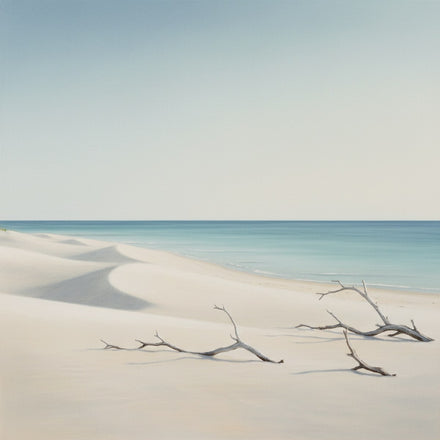
The cool palette is turquoise water, grey green swell, white foam and pale sky. It behaves like a neutral. Hang it and the room stays calm, because there is no strong hue competing with the walls or the furniture.
The warm palette is sunrise and sunset: orange sky, gold water, palm silhouettes. It behaves like a feature piece. The room organizes itself around it, which is what you want above a sofa and what you do not want on four walls of a bedroom.
Worth knowing before you browse: coastal photography as a category skews warm. Sunset and tropical scenes outnumber cool grey seascapes by a wide margin, because that is what photographers shoot. If you want the pale, almost colorless look, you have to search for it deliberately rather than assume it is the default.

Pretty light is the obvious answer and the incomplete one. Low sun does three specific things to a seascape that midday sun cannot.
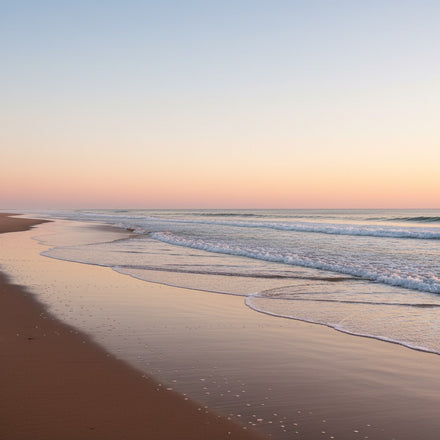
It puts a horizontal band of color across the frame, which suits a horizontal wall. It turns palms, piers and rock stacks into silhouettes, so the composition becomes shape rather than detail. And it makes water reflective, so the bottom half of the image mirrors the top half and the picture gains symmetry it would not otherwise have.
Midday coastal photographs are harder to hang. The light is flat, the water reads as one solid color, and the horizon becomes a hard line splitting the frame in two. Pieces such as Turquoise Ocean Wave work at midday precisely because they crop the horizon out entirely and treat the water as texture.

Coastal art divides into three subjects, and they suit different walls.
Water alone means waves, swell and barrel shots with no land in frame. This is the closest coastal art gets to abstract, so it hangs well in a room that already has a lot going on. It is also the safest choice for a small wall, because there is no scene to lose when the image is printed small.
Shoreline means beach, palms, piers and rock stacks: a scene with a foreground. It needs more wall than water alone, because the detail in the foreground has to stay readable.
Horizon means open sea meeting open sky, often with a single small subject like a boat or an island. This is the most restful and the most demanding of width. A horizon piece on a narrow wall loses the emptiness that makes it work.

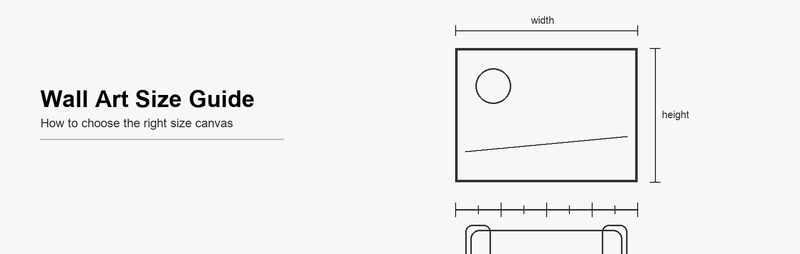
Use the two thirds rule. Artwork above a sofa, bed or console should span roughly two thirds the width of the furniture below it. A standard three seat sofa is about 84 inches wide, so the artwork above it should measure about 56 inches across. Full measurements are in the wall art size guide.
Coastal work rewards width more than most subjects, because the horizon is the compositional line and a horizon needs room to run. This is the one category where a panoramic format is often the correct answer rather than a stylistic flourish. Pieces shot as panoramas, such as Banzai Pipeline Barrel Wave, are built for that shape rather than cropped into it.
Every piece in the collection is offered as a single canvas or as a multi-panel set, chosen on the product page. Multi-panel suits horizon work particularly well, because the gaps between panels fall into open water and open sky rather than cutting through a subject.

It works in a bedroom, where the cool palette supports sleep and the horizon gives the eye somewhere to rest. It works in a living room above a sofa, where a warm sunset piece gives the room a focal point. It works in a hallway, where a long horizontal seascape suits a long narrow wall.
It fights a room that already has a strong competing scheme. A warm sunset piece in a room built on cool greys will look like it was chosen for a different house. Match the palette to the room first and the subject second, because palette is what the eye reads from across a room.
One practical caution: canvas is not rated for humid rooms, so a bathroom is not the place for it however well the subject seems to fit.
Start with Coastal Wall Art, which draws together sea, beach and tropical coastline. For shoreline scenes specifically, Beach Wall Art. For the warm palm and island end, Tropical Wall Art. If you are matching a cool scheme, Blue Wall Art is the better starting point, and for the widest horizon formats, Panoramic Wall Art.
For a whole room built around the style rather than a single piece, see nautical bedroom ideas and beach house decoration ideas.
Quick answers
Artwork that puts sea, shore or tropical coastline on a wall. It covers waves and open water, beach and pier scenes, and horizon views where sea meets sky. The defining split is palette: cool blue and grey pieces behave as neutrals, warm sunset pieces behave as focal points.
Cool coastal art sits with white, pale grey, sand and natural wood, which is why it suits an already neutral room. Warm sunset coastal art needs a room that can take orange and gold, so it pairs better with terracotta, cream and warm wood than with cool grey.
No. The cool palette functions as a neutral in any room, and a single horizon piece reads as calm rather than themed. What makes a room look like a themed beach house is quantity and repetition, so one considered piece avoids the problem that a gallery wall of shells creates.
About two thirds the width of the sofa, so roughly 56 inches above an 84 inch three seat sofa. Coastal work rewards extra width more than most subjects, because the horizon is the compositional line and it needs room to run across the wall.
Canvas is not rated for humid rooms, so a bathroom is not a suitable place for a canvas print even though the subject seems to suit it. A hallway, bedroom or living room wall is the better choice for coastal work.
Shop this guide
Every collection this guide mentions. Each one opens on artwork printed to order on museum-quality canvas.
Pieces shown above
Every piece this guide shows, printed to order on museum-quality canvas.
Keep reading
Guides that pick up where this one stops.