

THURSDAY SALE! • EXTRA 10% OFF + FREE SHIPPING DEAL | CODE: THURSDAY10
THURSDAY SALE! • EXTRA 10% OFF + FREE SHIPPING DEAL | CODE: THURSDAY10

Desert wall art means two different landscapes. One is the American Southwest: saguaro cactus, red rock buttes and a warm boho palette. The other is the sand sea: dunes, camel caravans and the Sahara, Namib or Gobi. They share a name and almost nothing else.

The Southwest desert has objects in it. A saguaro, a butte, a road sign, a skull. The eye lands on a shape and reads the picture as a place with things standing up in it, which is why that strand pairs so easily with Western and boho decorating.
The sand sea has almost nothing in it. Ridges, shadow and a horizon, sometimes a caravan for scale. It reads as texture and light rather than as scenery, and it behaves in a room more like an abstract piece than like a landscape.
That difference decides the room. A saguaro at sunset is a focal point and wants a wall of its own. A field of dune ripples is a surface and sits happily behind furniture, beside other pieces, or in a pair.

Dunes, sand ripples, camel caravans, oases and the Sahara lead here by a wide margin, with Namib, Gobi, Uluru and the Tunisian and Israeli deserts alongside them. The Southwest strand exists but it is the minority: Monument Valley, a handful of saguaro sunsets, Yucca and Arizona road scenes.
Worth saying before you browse: there is exactly one saguaro cactus piece here. If a cactus print is the whole reason you are searching, this is not the collection for it.
What the collection does hold in depth is the thing photographers actually go to deserts for, which is light on sand. Sand Ripples on Desert Dunes is the clearest example: no subject at all, just the pattern the wind left.

The caravan pieces are the most repeated composition in this collection, and the reason is compositional rather than romantic.
A dune has no built-in sense of size. Without something known in the frame, a ridge 300 feet high and a ripple 3 inches high look identical in a photograph. A line of camels fixes that instantly, and the picture goes from an abstract texture to a place you can judge the size of.
So choose on what you want. A caravan piece reads as a journey and a landscape. A pure dune piece reads as pattern, and hangs more like a textured abstract than like a photograph.

Almost every piece here brings orange, gold, ochre and warm brown, because most of them are shot at sunrise or sunset when the low sun rakes across the ridges and makes the shadows.
That sits with terracotta, oak, rattan, cream, unglazed ceramic and brass. It fights with cool grey and navy, which turn warm sand a muddy beige. If the room is cool toned, the two exceptions are the night pieces and the black and white work, where the warmth is gone and only the shape of the dunes is left.
Black and white desert is worth knowing about, since it is one of the most searched variants of this term. Stripped of color, a dune becomes pure line and shadow and stops being a warm decorating choice at all.

Go wide. A desert picture is built on a horizon, and cropping to a square throws away the emptiness that makes it work.
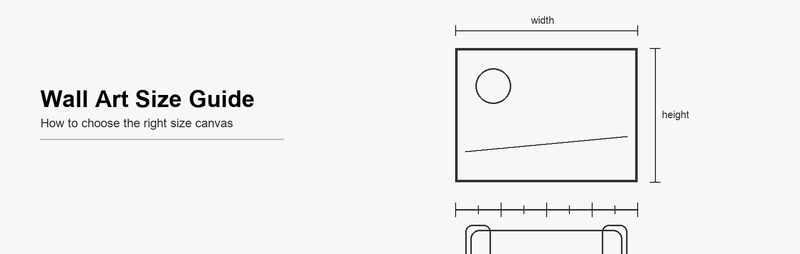
Above furniture, span about two thirds the width of what sits below, with 6 to 8 inches of clear wall between them. On a bare wall, center the piece 57 to 60 inches from the floor. The wall art size guide has the full numbers.
Every piece is offered as a single canvas or as a multi-panel set. Dunes split unusually well, because the gaps between panels fall in empty sand and interrupt nothing. Keep a single saguaro, a lone tree or a rock formation as one canvas so no gap runs through the subject.
Living rooms and bedrooms take the warm sunset work, which behaves like a color decision as much as a picture. A dining room suits the caravan and oasis pieces, since they carry enough story to look at across a long meal.
A home office or hallway suits the pure dune and black and white pieces, because pattern holds up under artificial light where a sunset can look flat. Avoid hanging a warm orange desert opposite a cool north window, where the daylight will fight the picture all afternoon.
Start with Desert Wall Art. For the Southwest strand instead, Arizona Wall Art and Utah Wall Art hold the red rock and butte country.
For the sand sea by region, Morocco Wall Art and Egypt Wall Art. If the low warm light is the real reason you are here, Sunset Wall Art gathers it across every landscape.
For rooms built on this palette, see why nature works as an interior reference and living room wall art ideas.
Quick answers
Artwork with a desert landscape as the subject, covering two distinct looks. The American Southwest strand shows saguaro cactus, red rock buttes and Western motifs. The sand sea strand shows dunes, ripples and camel caravans in the Sahara, Namib or Gobi. The first has objects in it, the second is texture and light.
Terracotta, oak, rattan, cream, unglazed ceramic and brass. Most desert pieces are shot at sunrise or sunset, so they carry orange, gold and ochre. Cool grey and navy work against them by turning warm sand a muddy beige. Night and black and white desert pieces are the exception.
Yes, especially the pure dune pieces. With no cactus, no signage and no obvious subject, a field of sand ripples reads as a textured abstract rather than as scenery, which is why it suits a plain modern room better than a saguaro sunset does.
For scale. A dune has no built-in size cue, so a ridge 300 feet high and a ripple 3 inches high photograph identically. A camel caravan gives the eye something known to measure against, which turns an abstract texture back into a place.
Wide rather than square. The subject is a horizon, and a square crop removes the emptiness that carries the picture. Above furniture, span about two thirds the width of what sits below with 6 to 8 inches of clear wall between them.
Shop this guide
Every collection this guide mentions. Each one opens on artwork printed to order on museum-quality canvas.
Pieces shown above
Every piece this guide shows, printed to order on museum-quality canvas.
 Desert Sunset with Saguaro Cacti Canvas Wall ArtFrom $69.95
 Sand Ripples on Desert Dunes Canvas Wall ArtFrom $69.95
 Camel Caravan Across Sahara Sand Dunes Canvas Wall ArtFrom $69.95
 Monument Valley Buttes in Warm Desert Light Canvas Wall ArtFrom $69.95
 Sandy Desert Under Starry Night Sky Canvas Wall ArtFrom $69.95
Keep reading
Guides that pick up where this one stops.