

FRIDAY SALE! • EXTRA 10% OFF + FREE SHIPPING DEAL | CODE: FRIDAY10
FRIDAY SALE! • EXTRA 10% OFF + FREE SHIPPING DEAL | CODE: FRIDAY10

Geometric wall art names two separate traditions. One is the modern Western line that runs from Malevich and Mondrian to mid-century shapes and hard-edged color blocks. The other is ornamental geometry: the mandala, Islamic square Kufic, aboriginal dot work and the fractal. They look nothing alike.
It has several names because it covers several things. In art history the modern strand is called geometric abstraction, and its sub-movements are Suprematism, De Stijl, Constructivism and Op Art. The ornamental strand is usually named after its own tradition instead: Islamic geometric pattern, mandala, tessellation, sacred geometry.
Nobody calls a mandala "geometric abstraction" and nobody calls a Mondrian "sacred geometry", yet a shop search for geometric wall art returns both. Knowing which one you want removes most of the work.

Flat planes, straight edges, primary or jewel colors, and no depth. The reference points are Kazimir Malevich's Black Square, Piet Mondrian's Composition II in Red, Blue and Yellow, Josef Albers' Homage to the Square and Bridget Riley's Movement in Squares.
This is the strand most retail sites lead with, usually as mid-century polygons and muted arches. It suits a room that is already modern: plain walls, low furniture, a limited palette. In a room with pattern already in it, hard-edged geometry competes rather than settles.
Those named works are museum pieces, not stock. What a print catalogue offers in this strand is work in the same visual language, which is worth knowing before you search for a specific painting by name.

Geometry built by repetition around a center rather than by placing shapes in a rectangle. It is older, denser and reads warmer.
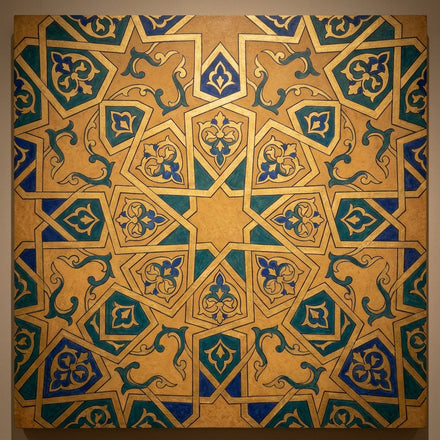
The mandala is concentric, symmetrical and built outward from a middle point. Square Kufic is Arabic calligraphy folded into a grid until the letters become a lattice, so it is text and pattern at once. Aboriginal dot work builds its geometry out of thousands of individual dots. The fractal repeats the same shape at every scale, and the Fibonacci spiral is the same idea drawn as a curve.
All four suit a room with texture in it: rugs, wood, brass, plants. They do not need a minimal room to work, which is the practical difference from the modern strand.

The ornamental strand, strongly. Mandalas and square Kufic calligraphy are the two largest groups, followed by gold-on-black lettering, fractals, aboriginal dot painting, concentric flower patterns and zodiac wheels.
Say it plainly: if you came for a Bauhaus arch print or a Mondrian-style color block, this is not the strongest collection for it. If you came for pattern that repeats around a center, it is.
There is also a small digital-grid group, Bitcoin and binary work, which is geometric in structure rather than in style. It is easy to spot and easy to skip.

This decides where a piece hangs, and it is more useful than the style label.
A centered pattern such as a mandala or a Kufic square has one focal point and wants to hang alone, centered on its wall, at a height where the middle of the pattern meets the eye. Hung off-center it looks like a mistake, because the symmetry makes the error obvious.
A repeating pattern with no single center, such as a tessellation or a dot field, is forgiving. It works in pairs, in threes, and off to one side of a wall, because there is no focal point to misplace.
The rule of thumb: symmetrical art needs a symmetrical position. Everything else can be arranged.

Pattern needs less size than a landscape does. A dense mandala at 24 x 16 inches carries a small wall, where a landscape at that size would look lost, because the detail rewards being close rather than being big.
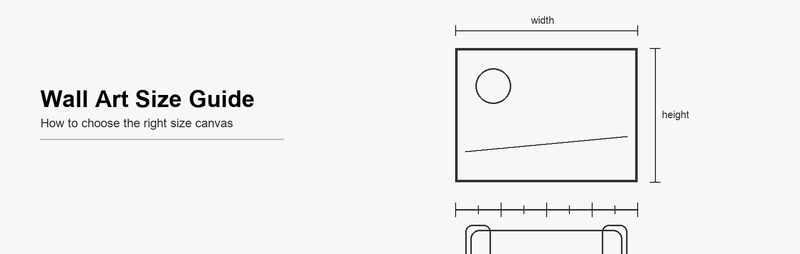
Above furniture the usual measure still applies: span about two thirds the width of what sits below, with 6 to 8 inches of clear wall between them. On a bare wall, center the piece 57 to 60 inches from the floor. Full measurements are in the wall art size guide.
Every piece here is offered as a single canvas or as a multi-panel set. Multi-panel and centered symmetry work against each other. A panel gap through the middle of a mandala cuts the thing that makes it a mandala, so keep symmetrical pattern as one canvas and save the sets for repeating designs.
Start with Geometric Wall Art. For the centered patterns specifically, Mandala Wall Art. For the lettering that becomes a lattice, Calligraphy Wall Art and Islamic Wall Art.
For the modern strand instead, Abstract Wall Art is the closer fit, and Minimalist Wall Art covers the plain-walled rooms hard-edged geometry suits.
For hanging several pieces together, see the gallery wall layout guide and living room wall art ideas.
Quick answers
The modern strand is called geometric abstraction, with Suprematism, De Stijl, Constructivism and Op Art as its movements. The ornamental strand is named by tradition instead: Islamic geometric pattern, mandala, tessellation, sacred geometry. Both turn up under one shop label.
Kazimir Malevich's Black Square (1913) and Dynamic Suprematism, Piet Mondrian's Composition II in Red, Blue and Yellow (1929) and Broadway Boogie Woogie, Josef Albers' Homage to the Square series, and Bridget Riley's Movement in Squares (1961). All are museum works rather than prints in stock.
Grids and color blocks, concentric circles, tessellations that tile without gaps, mandalas built outward from a center, square Kufic lattices, dot fields, fractals that repeat at every scale, and the Fibonacci spiral. The first two belong to the modern strand, the rest to the ornamental one.
Yes, better than most subjects. Pattern rewards being seen close, so a dense design at 24 x 16 inches carries a small wall where a landscape at that size would look lost. Keep to one piece in a small room, since pattern on pattern gets busy fast.
One, if the design is symmetrical. A mandala or a Kufic square has a single center and reads best alone and centered on its wall. Repeating designs with no focal point hang well in pairs or threes, and tolerate being placed off to one side.
Shop this guide
Every collection this guide mentions. Each one opens on artwork printed to order on museum-quality canvas.
Pieces shown above
Every piece this guide shows, printed to order on museum-quality canvas.
Keep reading
Guides that pick up where this one stops.