

MONDAY SALE! • EXTRA 10% OFF + FREE SHIPPING DEAL | CODE: MONDAY10
MONDAY SALE! • EXTRA 10% OFF + FREE SHIPPING DEAL | CODE: MONDAY10

The golden ratio in art is a proportion, roughly 1 to 1.618, that shows up in compositions the eye reads as balanced without knowing why. Photographers use it to place a horizon or subject so the frame feels resolved rather than arbitrary. It is composition, not art history, and it applies directly to choosing wall art.
The ratio itself comes from mathematics, but the reason it matters here is practical: it explains why some photographs and abstract pieces feel settled at a glance and others feel randomly cropped, which is a real factor in choosing artwork, not a trivia fact.

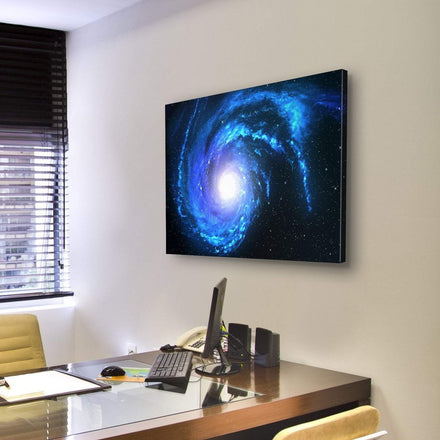
The golden spiral, a curve built from nested golden rectangles, is the famous visual shorthand for the ratio, and it shows up literally in some photography and abstract work, most naturally in spiral galaxies, nebulae and other cosmic subjects where the shape occurs on its own.
But most compositions that use the golden ratio do not show a visible spiral at all. The ratio more often works invisibly, deciding where a horizon or a subject sits in the frame, which is the version worth understanding for choosing art rather than just recognizing.

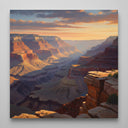
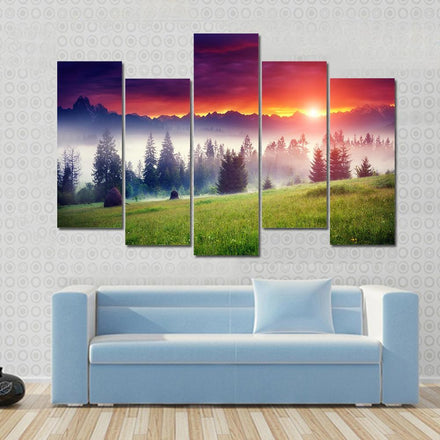
In landscape photography, the golden ratio places the horizon at roughly 38 percent or 62 percent of the frame height, never dead center. A centered horizon splits the image into two equal, competing halves; an off center horizon gives one half priority and reads as more deliberate.
This is worth checking on any wide landscape piece before buying: look at where the horizon actually sits. A photograph that follows this proportion reads as composed; one with a centered horizon can read as a snapshot even at a large size.

In abstract work, the golden ratio governs where a shape, a color block or a line sits relative to the frame's edges. A piece built on the proportion has an internal logic even without an obvious subject, which is why it can hold a wall on its own the way a piece with no compositional structure cannot.
Abstract Wall Art is the range where this matters most, since there is no recognizable subject to fall back on if the composition itself does not work.

Spiral galaxies and nebulae are the most literal examples, the golden spiral occurring in the actual subject rather than just the framing. Architectural photography and cityscapes often use it for where a building or skyline sits against open sky. Photography Wall Art carries both.
Minimalist compositions rely on it most heavily of all, since a single object or line is the entire image and its placement is the entire decision. Minimalist Wall Art is worth checking against this rule specifically.

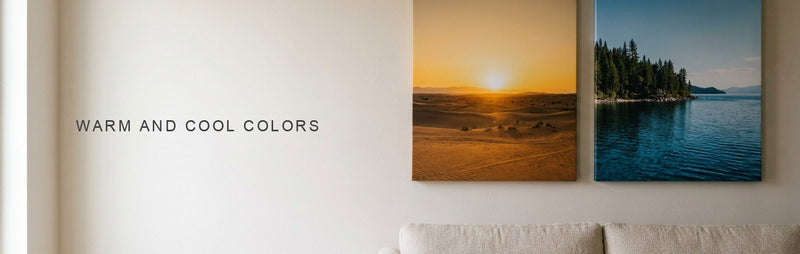
Look at where the main subject or horizon sits in the frame before buying. Off center, roughly a third or two thirds of the way across or down, generally reads as more deliberate than dead center. This is not a rule that overrides personal taste, but it explains a real, measurable reason some photographs feel more resolved than others at the same size and subject. The rule of thirds guide covers the closely related grid version of this same idea, and the warm and cool colors guide covers the other half of what makes a composition read as resolved, beyond placement alone.
Quick answers
A proportion of roughly 1 to 1.618 that artists and photographers use to place a subject, horizon or shape within a frame so the composition reads as balanced. It shows up literally as a spiral in some cosmic photography, and invisibly as placement in most other compositions.
It explains why some photographs and abstract pieces feel resolved at a glance and others feel randomly cropped. A landscape with the horizon placed off center, roughly a third of the way up or down, generally reads as more deliberate than one with a centered horizon.
Sometimes literally, most naturally in spiral galaxies and nebulae where the shape occurs in the actual subject. More often the ratio works invisibly, governing where a horizon or subject sits in the frame rather than appearing as a visible spiral shape.
In abstract work with no recognizable subject, the placement of a shape, color block or line relative to the frame's edges is the entire composition. A piece built on the golden ratio has an internal logic that holds a wall on its own even without a subject to rely on.
Related but not identical. The rule of thirds divides a frame into equal thirds; the golden ratio divides it at roughly 38 and 62 percent, a slightly different split. Both push a subject away from dead center, and both explain the same instinct that a centered composition often feels static.
Shop this guide
Every collection this guide mentions. Each one opens on artwork printed to order on museum-quality canvas.
Pieces shown above
Every piece this guide shows, printed to order on museum-quality canvas.
Keep reading
Guides that pick up where this one stops.