

THURSDAY SALE! • EXTRA 10% OFF + FREE SHIPPING DEAL | CODE: THURSDAY10
THURSDAY SALE! • EXTRA 10% OFF + FREE SHIPPING DEAL | CODE: THURSDAY10

Picture hanging height has one working answer: put the center of the piece 57 to 60 inches from the floor. That covers most walls in most homes, and it is the height galleries and museums use. Everything else here is the exceptions: furniture below it, high ceilings, groups, and where the nail goes.

The 57 inch rule puts the center of the artwork 57 inches from the floor. It comes from gallery practice, where 57 inches is taken as average standing eye level, and it is why a whole room of art hung this way lines up.
The number that matters is the center of the piece, not the top and not the hook. A tall canvas and a small one hung to the same 57 inch center will look like a set even though their tops are nowhere near each other.
Both are in use and both are correct, which is the reason for most of the confusion.
57 inches is the gallery standard and suits rooms where people are mostly seated, or where ceilings are 8 feet. 60 inches is the interior design convention and suits taller rooms, hallways where people are always standing, and households of taller people.
The practical answer: pick one number for the whole home and use it everywhere. Consistency across a house reads as deliberate. Mixing 57 in one room and 60 in the next is visible even when nobody can say why.

This is the exception that overrides the rule, and it is the most common mistake.
When there is a sofa, bed, console or sideboard below the picture, measure from the furniture rather than the floor: leave 6 to 8 inches between the top of the furniture and the bottom of the frame. Anything more and the piece floats away from the furniture and looks stranded.
On a tall-backed sofa that gap will push the center above 60 inches. That is correct and you should let it. The eye reads the picture and the furniture as one block, so the relationship between them matters more than the absolute height.

The 2/3 rule is about width rather than height, and the two questions usually arrive together. Artwork should span roughly two thirds the width of the furniture beneath it.
A 72 inch three seat sofa wants about 48 inches of art. A 60 inch console wants about 40. A queen headboard, 60 inches wide, wants about 40; a king at 76 inches wants about 50. Under half the furniture width looks stranded no matter how perfectly the height is set.
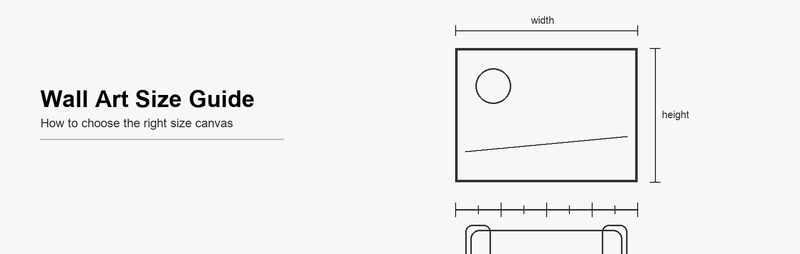
Worth knowing before you measure: in the horizontal range here the widest single canvas is 48 x 32 inches, so a 72 inch sofa is the last one a single piece serves at two thirds. Wider walls need a multi-panel set. Full sizing is in the wall art size guide, and the sofa case specifically is in what size wall art goes above a sofa.
The center height is the target. The hook sits above it, and by how much depends on the hardware, so it has to be measured rather than guessed.
Working in centimeters, 57 inches is 145 cm and 60 inches is 152 cm. The 6 to 8 inch furniture gap is 15 to 20 cm.

With 8 foot ceilings, use 57 inches. With 9 foot ceilings, 60 is usually better. With 10 feet or more, go to 60 to 62 and stop there.
The instinct with a vaulted or double height wall is to hang high so the piece sits in the middle of the wall. Resist it. Eye level does not move when the ceiling does. Art hung at 8 feet is art nobody looks at properly.
The right answer on a very tall wall is a bigger piece, or a vertical arrangement that starts at normal height and runs upward, rather than one normal piece pushed up out of reach.

For a gallery wall, treat the whole arrangement as one rectangle and put the center of that rectangle at 57 to 60 inches, with 2 to 3 inches between frames. The gallery wall layout guide covers spacing in full.
Up a staircase, follow the pitch of the stairs rather than the floor: measure 57 to 60 inches from each tread, so the line of pictures climbs at the same angle as the handrail.
Above a bed, the headboard is the furniture, so use the 6 to 8 inch gap from the top of the headboard. Details are in wall art above a bed.
Over a fireplace, use the mantel as the furniture and keep the same gap. In a hallway where everyone is standing, take the higher end of the range.
For pieces that suit the standard above-furniture position, Horizontal Wall Art and Large Wall Art. For a wall that is wider than a single canvas can serve, Panoramic Wall Art.
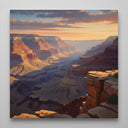
For the tall narrow walls that need a different approach, Vertical Wall Art. Two subjects that hold up well at these heights are Mountain Wall Art and City Wall Art.
Quick answers
Hang the center of the artwork 57 inches from the floor. It comes from gallery practice, where 57 inches is treated as average standing eye level. The measurement is to the center of the piece, not the top or the hook, which is why differently sized pieces still line up.
The same idea with the center at 60 inches instead. It is the interior design convention rather than the gallery one, and it suits 9 foot ceilings, hallways where people are standing, and taller households. Pick one number and use it throughout the home.
Artwork should span about two thirds the width of the furniture below it. A 72 inch sofa takes roughly 48 inches of art, a 60 inch console about 40, and a king headboard at 76 inches about 50. It governs width, while the 57 or 60 inch rule governs height.
Measure from the couch, not the floor. Leave 6 to 8 inches between the top of the sofa back and the bottom of the frame. On a tall-backed sofa that puts the center above 60 inches, which is correct, because the eye reads the picture and the furniture as a single block.
At normal eye level, 60 to 62 inches to the center. Eye level does not rise with the ceiling. Hanging high to fill a vaulted wall puts the art where nobody can look at it properly. Use a larger piece or a vertical arrangement that starts at normal height and runs upward instead.
Shop this guide
Every collection this guide mentions. Each one opens on artwork printed to order on museum-quality canvas.
Pieces shown above
Every piece this guide shows, printed to order on museum-quality canvas.
Keep reading
Guides that pick up where this one stops.