

WEDNESDAY SALE! • EXTRA 10% OFF + FREE SHIPPING DEAL | CODE: WEDNESDAY0
WEDNESDAY SALE! • EXTRA 10% OFF + FREE SHIPPING DEAL | CODE: WEDNESDAY0

Rustic wall art splits by material before it splits by subject. Most of what sells under this term is a hand painted wood sign or a reclaimed plank piece, made as an object. What is here is photography of rustic places printed on canvas, which is flat and behaves differently.
If you picture routed lettering on weathered boards, that is the woodworking market and it is well served. If you picture a cabin under snow, read on.

On canvas, rustic has to be carried by the subject, because the surface itself is smooth. That works because the subjects are strong: log cabins, alpine villages, barns, pine forest, mountain lakes and weathered timber shot close.
Those recur throughout this range, with wood, cabins, lakes and mountains the most common by a wide margin. What you are buying is a photograph of a rustic place rather than a rustic object. Rustic Wall Decor is the range built on it.

A large share of these pieces are shot in snow, and there is a reason beyond the season. Snow removes clutter. It covers ground detail, flattens the background and leaves the built structure as the only dark shape in the frame, so a cabin reads as a cabin rather than as one object among many.
It also supplies the light. A lit window against snow at dusk is the single most reliable composition in this category, because the warm point of light gives the eye somewhere to land in an otherwise cold frame. Winter Season Wall Art holds the wider set.

They get shelved together and they are not the same. Rustic is rough and rural: timber, stone, mountain, cabin. Farmhouse is tidier and agricultural: barns, fields, painted wood, a lighter palette. Industrial is urban and hard: brick, steel, warehouse windows, gray.
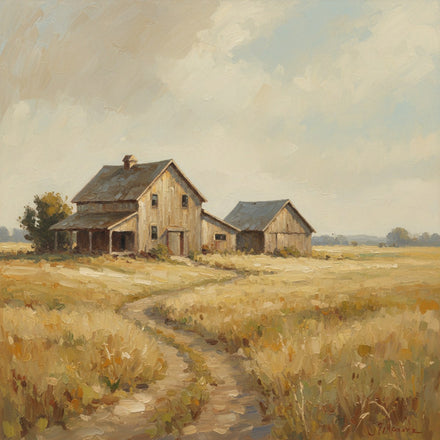
The practical test is the material in the picture. Unfinished timber and stone are rustic. Painted board and open farmland are farmhouse. Metal and brick are industrial. Mixing all three in one room is the most common way this look goes wrong. Farmhouse Wall Decor is the neighboring range.

Timber, stone and dry grass sit in the brown, ochre and gray band, and snow adds a cool blue only in the shadows. That combination goes into a room with wood floors, leather or exposed beams without any effort at all.
Where it struggles is a cool modern room with white walls and black metal, because there the warmth reads as out of place rather than as contrast. In that case go for the winter end of the range, where the palette is colder and the composition is more graphic. The earth tone guide covers the warm band, and the neutral guide covers keeping it quiet.
No carved or routed wood signs, no reclaimed plank assemblies, no cut metal silhouettes, no lettering and nothing handmade to order. Those make up a large part of this market and other sellers specialize in them.
The trade is worth understanding rather than glossing over. A wood piece has real depth and shadow and reads as furniture, and it needs side lighting to show that relief. A canvas is flat, unaffected by lighting angle, works in a hallway with no natural light, and scales up far more cheaply. Neither is better; they are different objects.

The usual proportion applies: about two thirds the width of the furniture below, so roughly 48 inches above a 72 inch sofa, with the center 57 to 60 inches from the floor. Horizontal work runs 1 Piece, 3 Horizontal, 4 Pop, 5 Star and 5 Pop from 24 x 16 to 82 x 42 inches.
One subject specific point. A mountain lake or an alpine valley is wide and wants the horizontal or panoramic range, which covers 36 x 12 to 73 x 24. A single cabin, a barn door or a stand of pines is tall, and cropping it wide throws away the part that makes it work; the vertical range at 12 x 24 to 24 x 49 inches suits those. The size guide has the method.
Quick answers
On canvas it is the subject rather than the material: log cabins, alpine villages, barns, pine forest, mountain lakes and weathered timber shot close. Wood signs and reclaimed plank pieces are also sold under the term, but those are objects with real relief rather than printed images.
The material in the picture. Rustic is rough and rural, meaning unfinished timber, stone, mountain and cabin. Farmhouse is tidier and agricultural, meaning barns, open fields, painted board and a lighter palette. Industrial is the third neighbor and is brick, steel and gray.
Because snow removes clutter and supplies light. It covers ground detail and flattens the background so the cabin or barn is the only dark shape in frame, and a lit window against snow at dusk gives the eye a warm point to land on in an otherwise cold image.
It can, as a single contrasting piece, but choose from the winter end of the range where the palette is cooler and the composition more graphic. The warm timber and stone end reads as out of place rather than as contrast in a room of white walls and black metal.
Match the shape of the subject. A mountain lake or alpine valley is wide and suits the horizontal range or panoramic at 36 x 12 to 73 x 24 inches. A single cabin, a barn door or a stand of pines is tall and suits the vertical range at 12 x 24 to 24 x 49 inches.
Shop this guide
Every collection this guide mentions. Each one opens on artwork printed to order on museum-quality canvas.
Pieces shown above
Every piece this guide shows, printed to order on museum-quality canvas.
Keep reading
Guides that pick up where this one stops.