

MONDAY SALE! • EXTRA 10% OFF + FREE SHIPPING DEAL | CODE: MONDAY10
MONDAY SALE! • EXTRA 10% OFF + FREE SHIPPING DEAL | CODE: MONDAY10

Sports wall art here means the game, not the team: equipment shot as still life, athletes as anonymous silhouettes, and venues at their most dramatic hour. There are no licensed team logos or named players in the range, and that constraint is what keeps the pieces from dating or dividing a room.
That may sound like a limitation. In practice it is why this artwork survives on a wall for years, because a jersey number ties a picture to a season while a silhouette under stadium lights stays true as long as the sport exists. The range splits into three kinds of picture.

A worn baseball filling the frame, snooker balls racked on green felt, a golf ball on the lip of the cup. Shot close and lit carefully, sports equipment becomes still life, and it reads instantly from across a room because the shapes are simple and universally known.
These are the easiest sports pieces to place because they behave like graphic art. The billiards and bowling images in Sports Wall Art hang naturally in a games room, and a single glowing tennis ball or football is at home in an office where a full stadium scene would shout.

The second group puts a player in the frame but takes the identity out: football players as black shapes under floodlights, a cyclist against a sunset ridge, a surfer inside the barrel of a wave. The figure stands for the sport itself rather than any career, which is exactly what a wall wants.
Silhouettes also solve the gift problem. A named star can be the wrong star in the wrong house; a bodybuilder mid lift or a snowboarder mid jump celebrates the effort without picking anyone's allegiance. For a gym wall, the motivation pieces in this group are the standard choice.

The third group has no player at all: a baseball stadium glowing at night, Pebble Beach at golden hour, an empty tennis court under lights. Venues photograph best at dusk, when the floodlights come on and the sky still holds color, and most of the range obeys that hour.
These are the widest images in the category and several run panoramic, which suits the shape of a stadium and the wall above a couch or headboard equally well. The Golf Wall Art range is mostly this group, and the golf guide covers the course versus close up decision that applies across every sport here.

The games room takes billiards, bowling and cards subjects because the room and the picture describe the same activity. The gym takes the effort pictures. The office takes golf and tennis, the two sports whose imagery reads as composed rather than loud. A kid's room takes soccer, the one sport with a genuinely global childhood.
The man cave takes almost anything in the category, which is why sports art is its default wall covering; the man cave guide argues for picking one subject and committing, and Man Cave Wall Decor holds the wider range beyond sport.

Football here means the American game: close ups of the laced ball, linemen silhouetted in formation, stadium light towers against dusk. The Football Wall Art range carries those, without team marks, which means a Cowboys house and an Eagles house can hang the same picture in peace.
Soccer appears throughout the wider sports range for the global game. If a search for athletics wall art or athlete prints brought you here, this is that category; the vocabulary varies, the pictures are the same.
Quick answers
Photography and artwork built on sport without team branding: equipment shot as still life, athletes shown as silhouettes, and stadiums or courses photographed at dusk. No licensed logos or named players appear, which keeps the pieces neutral enough to hang for years without dating.
Team marks and player likenesses are licensed property, so the range is built on the game itself instead. That turns out to be a design advantage: a silhouette or an equipment close up cannot go out of date when a roster changes, and it never divides a room of mixed fans.
Games rooms take billiards and bowling subjects, gyms take the effort and motivation pieces, offices take golf and tennis, kids rooms take soccer, and the man cave takes nearly all of it. Matching the sport to what happens in the room matters more than matching it to the fan.
Equipment close ups work from 24 x 16 inches because the shapes are simple. Stadium and course scenes want width, about two thirds of the furniture below, and several run panoramic for exactly that reason. Horizontal layouts run from single pieces up to five panel sets at 82 x 42 inches.
It is one of the safer ones, precisely because the range avoids named players and team marks. A stadium at night or a silhouetted athlete celebrates the sport someone loves without guessing their allegiance, which is the mistake most sports gifts make.
Shop this guide
Every collection this guide mentions. Each one opens on artwork printed to order on museum-quality canvas.
Pieces shown above
Every piece this guide shows, printed to order on museum-quality canvas.
 Snooker Balls Set on a Green Table Canvas Wall ArtFrom $69.95
 American Football Silhouettes Under Stadium Lights Canvas Wall ArtFrom $69.95
 Night Game at Grand Baseball Stadium Panoramic Canvas Wall ArtFrom $98.95
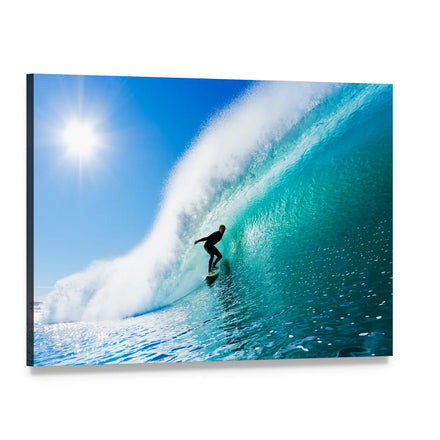 Surfer in Turquoise Barrel Wave Canvas Wall ArtFrom $69.95
 American Football Close-up with White Laces Canvas Wall ArtFrom $69.95
Keep reading
Guides that pick up where this one stops.