

MONDAY SALE! • EXTRA 10% OFF + FREE SHIPPING DEAL | CODE: MONDAY10
MONDAY SALE! • EXTRA 10% OFF + FREE SHIPPING DEAL | CODE: MONDAY10

Staircase wall art works best when it follows the rake of the stairs rather than sitting on one level line. Hang each piece so its center stays a consistent height above the stair nosing directly beneath it, which keeps the arrangement parallel to the handrail. Tall, vertical pieces suit stairwell walls better than wide ones.
A stairwell is the hardest wall in the house to hang art on, because the two rules people normally rely on both stop working. The floor is not level, so there is no single height to measure from. And you never stand still to look, so the viewing distance changes with every step.
The usual convention on a flat wall is to set the center of the artwork at roughly eye level, around 57 to 60 inches from the floor. That number exists because gallery visitors stand on a level floor at a predictable distance.
On a staircase neither condition holds. Measure 57 inches from the bottom step and the piece will be at knee height by the top. Measure from the top and it disappears above the sightline at the bottom.
Use the stair nosing as your datum instead of the floor. The nosing is the front edge of each tread. Pick a height, for example 60 inches, and measure that distance vertically from the nosing directly below each piece. Because the nosings climb at a constant angle, every piece lands on a line parallel to the stairs and to the handrail. That parallel line is what makes an arrangement read as deliberate.

Stairwell walls are usually tall and narrow, often the tallest uninterrupted wall in the house, and they are viewed at an angle rather than straight on. A wide horizontal canvas fights that shape twice: it competes with the diagonal of the stairs, and its far edge is always further from you than its near edge.
A vertical piece does the opposite. It echoes the height of the wall, and its narrow width keeps the whole image at a similar distance as you climb.
That is why our staircase wall art collection is built from vertical pieces. They come in two layouts, a single vertical panel or a set of three verticals, in six sizes from 12 by 24 inches up to 24 by 49 inches. Every piece is printed to order on museum quality canvas with archival inks that resist fading, stretched over a solid wooden inner frame and ready to hang. Vertical pieces are produced as gallery wrapped canvas prints rather than framed, which also keeps the weight down on a wall you have to reach from a ladder.

Measure the usable wall, not the whole wall. The usable area on a stairwell is bounded by the handrail below and the ceiling line above, and it is narrower than it looks.
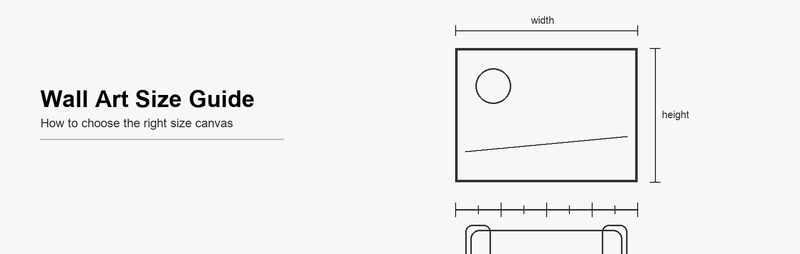
On a typical run, that lands most people on the 18 by 36 inch or 24 by 48 inch sizes for a single piece. If the wall is short but wide, a set of three verticals hung in a stepped line usually reads better than one canvas turned sideways. Our wall art size guide covers the measuring method in more detail.

Three arrangements cover nearly every stairwell.
Keep spacing between pieces consistent, and measure it along the horizontal, not along the slope. Spacing measured on the diagonal looks uneven once the pieces are level.
If you want a denser arrangement of mixed sizes rather than a simple line, the method is different and worth reading separately in our gallery wall layout guide.

Stairwells are usually short on natural light and long on wall, and you see the art in passing rather than sitting with it. Two practical consequences:
Contrast reads better than detail. A finely detailed image loses its subject in low light and at speed. High contrast subjects hold up. That is one reason black and white wall art suits stairwells, since the whole image is built on contrast rather than color.
Continue the palette from the room the stairs open into. A stairwell is a connector, not a destination. Matching it to the adjoining living room wall decor makes the transition feel considered, and stops the stairwell reading as a leftover space.
For subject choices rather than sizing, our staircase wall decor ideas covers fifteen arrangements with photographs.
This is the one place where the fixing matters more than the look. A canvas that comes off a stairwell wall falls onto stairs, and often onto someone using them.
Adhesive strips can work for lighter pieces on a smooth stairwell wall, but read the weight rating carefully and treat anything above stairs as a case for a mechanical fixing.
Quick answers
Hang pieces so each one sits at the same height above the stair nosing directly beneath it, which puts the arrangement on a line parallel to the handrail rather than level with the floor. Choose vertical pieces over wide ones, keep at least 4 to 6 inches clear above the handrail, and keep horizontal spacing between pieces consistent.
Measure from the handrail to the ceiling at the middle of the run and use about two thirds of that height as your maximum for a single piece. For most stairwells that means an 18 by 36 inch or 24 by 48 inch vertical canvas. If the wall is short and wide, three smaller verticals in a stepped line work better than one canvas turned sideways.
Around 60 inches measured vertically from the stair nosing below each piece, rather than from the floor. Because the nosings rise at a constant angle, measuring from them puts every piece on a consistent line that follows the stairs. Measuring from the floor instead leaves the arrangement too high at one end and too low at the other.
The wall at the top of a run is seen straight on, unlike the angled wall beside the stairs, so it suits a single larger piece rather than part of a stepped sequence. It is also the point where the stairwell meets a landing or hallway, so matching the palette of the adjoining room keeps the transition coherent.
Gallery wrapped canvas is the practical choice above stairs. It weighs less than a framed print of the same size because it carries no glazing, which matters on a wall you have to reach from a ladder, and there is no glass to break onto the stairs if a fixing ever fails. Our vertical pieces are produced as canvas prints for this reason.
Shop this guide
Every collection this guide mentions. Each one opens on artwork printed to order on museum-quality canvas.
Pieces shown above
Every piece this guide shows, printed to order on museum-quality canvas.
Keep reading
Guides that pick up where this one stops.