

MONDAY SALE! • EXTRA 10% OFF + FREE SHIPPING DEAL | CODE: MONDAY10
MONDAY SALE! • EXTRA 10% OFF + FREE SHIPPING DEAL | CODE: MONDAY10

The seven classical types of art are painting, sculpture, literature, architecture, theater, film and music. That list is the most widely taught, but it is not the only one, and the reason different sources say seven, nine, ten or sixty four is the single most confusing thing about this subject.
This page gives the standard list, explains exactly why the count keeps changing, and separates three things that are constantly mixed up: an art form, an art style and an art medium.

The seven art forms in the classical list are:
This list has a specific origin. The Italian critic Ricciotto Canudo argued in the early twentieth century that cinema was a new art that fused the older ones, and his 1923 Manifesto of the Seven Arts fixed film as the seventh. The six he counted before it were architecture, sculpture, painting, music, poetry and dance. Film is still called the seventh art in French and Italian criticism today.
Note what that means. The number seven is a hundred year old argument about cinema, not a law of nature.
Because each number answers a slightly different question, and none of them is wrong.
Five comes from philosophy. Hegel, in lectures published in 1835, ranked architecture, sculpture, painting, music and poetry as the fine arts, ordered by how far each escapes physical matter.
Seven comes from Canudo and the argument about film, described above.
Eight and nine are modern extensions. Once film is admitted, the same logic admits photography, and then comics, and then video games, which are sometimes called the ninth art. The list grows whenever a new medium demands to be taken seriously.
Ten and twelve usually appear in teaching materials that fold in dance, printmaking, ceramics and digital art as separate entries rather than as branches of the seven.
Sixty four comes from a different tradition entirely. Classical Sanskrit texts, most famously the Kamasutra of Vatsyayana, list sixty four kalas or arts, and they include garland making, cooking, carpentry and swordsmanship alongside painting and music. It is a list of accomplishments a cultured person should possess, not a taxonomy of fine art, which is why the number looks so strange next to a Western list.
The practical answer: if you need one number, say seven, and know that it is a convention.

The visual arts are the types of art you experience by looking, and this is the branch most people mean when they say art.
It includes painting, drawing, sculpture, printmaking, photography, ceramics, textile art and architecture, along with newer entries like digital and video art. What unites them is that the work exists as an object or image rather than as a performance or a text.
The other two branches are the performing arts, which exist in time and need performers, covering music, dance, theater and opera, and the literary arts, which work through written language.
This split is about purpose, not quality, and the distinction is older than it is useful.
Fine art is made primarily to be looked at and thought about, with no practical function. Painting and sculpture are the standard examples.
Applied art puts design into functional objects. Furniture, ceramics, typography and industrial design are applied arts, where the thing must work as well as look right.
Decorative art covers objects made to ornament a space, such as textiles, glass and metalwork.
The hierarchy implied here, with fine art on top, was challenged throughout the twentieth century. William Morris argued from the 1860s that the division impoverished both sides, and Marcel Duchamp's Fountain of 1917, a mass produced urinal submitted as sculpture, attacked the boundary directly. Most curators now treat the categories as descriptive rather than ranked.
A style is how a work looks and what its makers were trying to do. These are not types of art; they cut across them.
Realism depicts subjects as they appear, without idealizing. It dominated Western painting for centuries and re-emerged as a deliberate movement in nineteenth century France.
Impressionism records the sensation of a moment, especially light, with visible broken brushwork. It takes its name from Claude Monet's Impression, Soleil Levant, exhibited in 1874, after the critic Louis Leroy used the title as an insult.
Expressionism distorts appearance to convey emotion, prioritizing inner feeling over accuracy.
Cubism fractures objects and shows several viewpoints at once. Pablo Picasso and Georges Braque developed it from about 1908, following Picasso's Les Demoiselles d'Avignon of 1907.
Surrealism stages dream logic and the unconscious. Salvador Dalí's The Persistence of Memory, painted in 1931, is the image most people picture.
Abstract art abandons recognizable subjects for pure color, shape and line. Wassily Kandinsky is usually credited with the breakthrough around 1910 to 1913, though the dating of his earliest abstract watercolor is disputed, and the Swedish painter Hilma af Klint was making fully abstract work from 1906, several years earlier, which is now widely acknowledged.
Pop art took its imagery from advertising and mass production. Andy Warhol's Campbell's Soup Cans of 1962 is the defining work.
Minimalism strips work to essential geometry and repetition. Donald Judd, one of the artists most associated with it, rejected the label.
If you are drawn to one of these, abstract wall art and minimalist wall art are the two styles that translate most directly onto a wall at home.
These three words are used interchangeably and mean different things. Getting them straight makes every other art discussion easier.
Form is the discipline. Painting, sculpture, film.
Style is the approach. Impressionist, abstract, realist.
Medium is the physical material. Oil, watercolor, bronze, charcoal.
One sentence uses all three correctly: an abstract oil painting is a painting by form, abstract by style, and oil by medium. A realist watercolor and an abstract oil share a form and differ in both style and medium.

The medium changes the finished surface more than most descriptions admit.
Oil paint dries slowly, which allows blending and layering, and holds thick texture. Acrylic dries fast and sits flatter. Watercolor is transparent and worked light to dark, so the paper does the lightest tones. Charcoal and graphite are drawing media built on value rather than color. Digital work is made on screen and has no single original object.
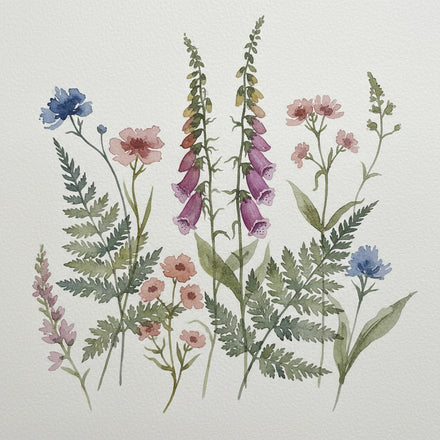
Reproduction flattens some of this. A canvas print keeps the woven surface, which reads closer to a painting than paper does, but the raised ridges of an original oil are lost. That is an honest limit of any print, and it is worth knowing before comparing one to an original. Watercolor art reproduces particularly well, because its effects are transparent rather than textured.

Only some of the seven forms hang on a wall, and among those the choice is mostly about style and scale.
For a focal point, a single large piece in a high contrast style. Abstract and geometric work carries from across a room because it reads as shape rather than detail.
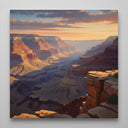
For calm, low contrast styles: soft landscape canvas prints, watercolor, or minimalist compositions with generous empty space.
For structure, geometric wall art, which brings pattern and rhythm into a room without competing with furniture.
Style matters more than subject in deciding how loud a piece will be. The seven elements of art explain the mechanism, and the seven principles of art cover how to arrange several pieces so they read as one group.
Quick answers
The seven classical types of art are architecture, sculpture, painting, music, literature, theater and film. The list comes from the Italian critic Ricciotto Canudo, whose 1923 Manifesto of the Seven Arts named cinema the seventh art after the six that preceded it. Film is still called the seventh art in French and Italian criticism.
Because each number answers a different question. Hegel counted five fine arts in lectures published in 1835. Canudo made it seven by adding film. Modern lists reach eight or nine by admitting photography, comics and video games. Sixty four comes from classical Sanskrit texts such as the Kamasutra, which list sixty four kalas including cooking and carpentry alongside painting.
Form is the discipline, such as painting, sculpture or film. Style is the approach, such as impressionist, abstract or realist. Medium is the physical material, such as oil, watercolor or bronze. An abstract oil painting is a painting by form, abstract by style and oil by medium.
The visual arts are the types of art experienced by looking, including painting, drawing, sculpture, printmaking, photography, ceramics, textile art and architecture, along with digital and video art. The other two branches are the performing arts, which exist in time and need performers, and the literary arts, which work through written language.
Fine art is made primarily to be looked at, with no practical function, as with painting and sculpture. Applied art puts design into functional objects such as furniture, ceramics and typography, where the object must work as well as look right. The implied ranking between them was challenged by William Morris from the 1860s and by Marcel Duchamp's Fountain in 1917.
Shop this guide
Every collection this guide mentions. Each one opens on artwork printed to order on museum-quality canvas.
Pieces shown above
Every piece this guide shows, printed to order on museum-quality canvas.
Keep reading
Guides that pick up where this one stops.