

WEDNESDAY SALE! • EXTRA 10% OFF + FREE SHIPPING DEAL | CODE: WEDNESDAY10
WEDNESDAY SALE! • EXTRA 10% OFF + FREE SHIPPING DEAL | CODE: WEDNESDAY10

Vertical wall art exists because most walls are not the shape most artwork is. Between two windows, beside a door, above a console, up a stairwell: these are tall narrow spaces, and a horizontal canvas either floats in the middle of them or does not fit at all.

Every room has at least one of them, and they are usually the walls left blank because nothing seemed to work.
The pier between two windows. The strip beside a doorway. The wall above a narrow console or a radiator. The space between a wardrobe and the corner. The rise of a stairwell, where the wall is tall by definition.
On all of those a wide canvas is the wrong tool. Hung small enough to fit the width it looks lost in the height; hung large enough to fill the height it does not fit the width. A vertical piece solves the geometry rather than compromising with it.

This is the part that decides whether a vertical piece looks deliberate or cropped. Some subjects gain from the format and some are simply landscapes squeezed into it.
Waterfalls are the best fit of all, because the subject is genuinely vertical. Waterfall with Stacked Cairn uses the full height as fall distance, so the format is doing work rather than just containing the image.
Trees and forest follow the same logic. Winding Road Through Autumn Forest at Sunset has trunks running top to bottom and a road leading away, which gives the eye a path down the frame.
Towers and tall architecture match the format by construction. A spire, a lighthouse or a city tower is already a vertical object.
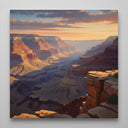
Canyons and cliffs work because depth becomes height. Grand Canyon National Park Landscape in vertical reads as looking down rather than across.
What struggles is the wide open landscape. A prairie, a wide lake or a horizon-based seascape loses most of what makes it work when the width is taken away, and a map is close to unusable vertically.

A horizontal picture is read left to right. A vertical one is read top to bottom, and that changes which part of the image carries the piece.
In a tall frame the top third is what the eye meets first and the bottom third is what it settles on. That is why a vertical sunset such as Sunrise Over Beach and Sea works: the color is at the top where the eye arrives, and the water below gives it somewhere to rest.
It is also why a vertical crop of a busy scene rarely works. Without a clear top and bottom relationship the eye has no route through the picture and the height feels arbitrary.

Standard advice puts the center of a piece at eye level, roughly 57 to 60 inches from the floor. A tall piece complicates that, because its center and its visual weight are not in the same place.
Hang a vertical canvas by its center and it often reads as too high, since the mass of the image sits above the eye. Dropping it so that the lower third falls at eye level usually looks better, particularly above furniture.
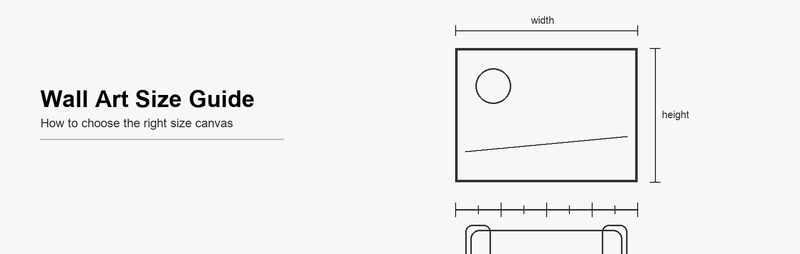
Above a console or a radiator, leave the same six to eight inch gap you would with any piece, and let the extra height run upward rather than starting higher. Full measurements are in the wall art size guide.

The two thirds rule still applies where there is furniture below: span roughly two thirds the width of the console or sideboard. On a bare wall between windows, the useful measure is different. Aim for the piece to occupy about two thirds of the available wall width and let the height follow the format.
Every piece in this collection is offered as a single canvas or as a multi-panel set, chosen on the product page. A vertical subject splits well into a tall multi-panel set, since the gaps run across the fall of a waterfall or the trunks of a forest without cutting a focal point. A single tall tower or spire is better as one canvas.
Start with Vertical Wall Art. For the subject that suits the format best, Waterfall Wall Art. For trunks and canopy, Forest Wall Art. For towers and tall architecture, City Wall Art, and for the exact opposite shape when the wall is wide instead, Panoramic Wall Art.
For the rooms these walls usually appear in, see hallway wall art ideas and staircase wall decor ideas.
Quick answers
Artwork in a portrait format, taller than it is wide. It exists for the tall narrow walls most rooms have and most artwork does not suit: between windows, beside a door, above a console, or up a stairwell.
Ones that are genuinely vertical: waterfalls, trees and forest, towers and tall architecture, and canyons where depth reads as height. Wide open landscapes and maps work least well, because the format removes the width that makes them work.
Lower than its center suggests. Hanging a tall piece by its center often reads as too high because the visual mass sits above the eye. Dropping it so the lower third falls at eye level usually looks better, especially above furniture.
Aim to occupy about two thirds of the available wall width and let the height follow the format. Above a console the usual rule applies instead: two thirds the width of the furniture, with a six to eight inch gap above it.
Yes, and unusually well. A tall set splits across the fall of a waterfall or the trunks of a forest without cutting through a focal point. A single tower or spire is better kept as one canvas.
Shop this guide
Every collection this guide mentions. Each one opens on artwork printed to order on museum-quality canvas.
Pieces shown above
Every piece this guide shows, printed to order on museum-quality canvas.
 Waterfall with Stacked Cairn Vertical Canvas Wall ArtFrom $99.95
 Winding Road Through Autumn Forest at Sunset Vertical Canvas Wall ArtFrom $99.95
 Sunrise Over Beach and Sea Vertical Canvas Wall ArtFrom $99.95
 Grand Canyon National Park Landscape Vertical Canvas Wall ArtFrom $99.95
 Heidelberg Abstract Cityscape Vertical Canvas Wall ArtFrom $99.95
Keep reading
Guides that pick up where this one stops.