

TUESDAY SALE! • EXTRA 10% OFF + FREE SHIPPING DEAL | CODE: TUESDAY10
TUESDAY SALE! • EXTRA 10% OFF + FREE SHIPPING DEAL | CODE: TUESDAY10

Bathroom wall art ideas start with position rather than product. Hang art on the wall furthest from the shower, outside the direct spray zone, in a room with working ventilation. The wall facing the door and the space above a towel rail are the two positions that reliably work.
A bathroom cycles between dry and very humid several times a day. That is a demanding environment for anything on the walls, and it is worth being straightforward about it rather than making claims that do not hold.
Tiaracle canvases are printed to order with archival inks that resist fading, and stretched over a solid wooden inner frame. What we do not claim is that any canvas is engineered for a steam room. So the sensible bathroom wall art ideas are the ones that put the piece somewhere the steam largely is not, in a room where the extractor actually works.
If your bathroom has no window and no functioning extractor, the honest advice is to fix the ventilation before hanging anything, or to keep the art in the hallway outside. That is a better answer than a product recommendation.
Ranked by how far each position sits from the steam:
For hanging technique on tiled or awkward surfaces, our guide to hanging art in a bathroom covers the fixings in detail. This article is about what to choose and where to put it.
The wall above a cistern is the most consistently wasted surface in a house. It is usually 20 to 30 inches wide, sits at a natural height, and is as far from the shower as the room allows. One vertical piece here, centerd on the cistern, finishes the room with a single decision.

Coastal wall art works in a bathroom for the obvious reason and one less obvious one: the palettes are usually pale and cool, which agrees with white sanitaryware and tile rather than fighting it. Keep it to water and light rather than literal beach objects, which date quickly.
A bathroom is a small room viewed from three or four feet away. Ocean wall art with texture and movement rewards that viewing distance, where a wide landscape at the same size would lose its detail. Close-range subjects generally outperform panoramas in small rooms.

All-white bathrooms can read as clinical. Botanical wall art introduces the only warm element in a room otherwise made of hard cool surfaces. Green also sits well beside real plants, which most bathrooms with any daylight can support.
Where the wall beside a basin is narrow, two small pieces stacked vertically use the height rather than fighting for width. Keep them 2 inches apart and treat the pair as one rectangle when centering. Clear the tap's splash radius, which is further than it looks with a high mixer.

Bathrooms with a separate shower enclosure and a freestanding bath have genuine wall space and are usually under-decorated. One large piece on the wall facing the bath turns the room from functional into somewhere you would spend time. Browse bathroom wall decor for subjects at that scale.
Standard height applies on open wall: center at 57 to 60 inches. Above fixtures, the fixture becomes the reference.
| Position | Measure from | Gap to leave |
|---|---|---|
| Above the toilet | Top of the cistern | 8 to 12 inches |
| Above a towel rail | Top of the rail | 6 to 10 inches |
| Beside the basin | Floor, center at 57 to 60 | Clear the tap splash radius |
| Open wall facing the door | Floor | Center at 57 to 60 inches |
Bathrooms are small enough that a piece hung two inches off will be noticed, because you see it against a grid of tile that makes any misalignment obvious. Where there is tile, align the piece to the tile grid rather than to the room, even if that means moving it slightly off true center.

A working extractor changes what a bathroom can hold more than any decision about subject or size.
Run the extractor during a shower and for fifteen to twenty minutes after, which is when most of the moisture is still airborne. Open a window if you have one. Keep the door open when the room is not in use, particularly in a small internal bathroom, so the air actually changes.
If the mirror stays fogged for a long time after a shower, the room is not clearing, and that is the signal to improve ventilation before adding anything to the walls. It is also worth checking that an extractor vents outside rather than into a loft space, which is a surprisingly common fault and makes the fan close to useless.

Bathrooms are mostly white, mostly reflective, and usually lit from directly overhead. Color behaves differently here than anywhere else in the house.
Cool colors amplify. Blues and greys that read as calm elsewhere can push a white tiled bathroom toward cold, particularly under a cool ceiling light. Warm colors do the opposite and are usually the better choice in a room with no daylight.
Contrast matters more than hue in a small room. A piece with strong tonal structure holds its own against a busy tile pattern, where a soft low-contrast piece gets absorbed by it. If the room has patterned tile or a strong floor, choose art with a simple shape and let the tile be the pattern.
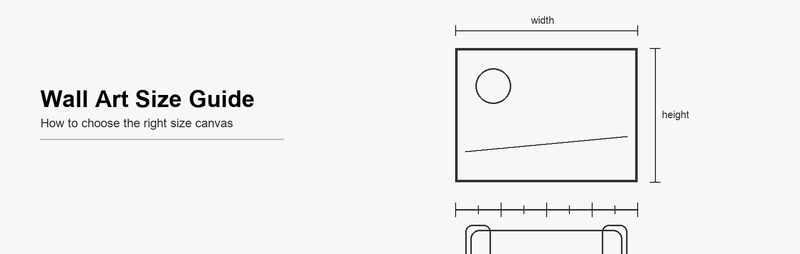
For proportions and sizing generally, the wall art size guide covers the rules this article adapts to a small room.
A cloakroom with no bath or shower has none of the humidity problem, and it is the most underused wall in most houses. There is no steam, the room is small, and guests spend a minute in it looking at whatever is there.
That combination makes a cloakroom the one place where you can be bolder than anywhere else in the house. A strong piece in a tiny room is genuinely enjoyable in a way the same piece in a living room might not be, because you are not living with it for hours.
Practical points for a very small room: hang at the standard 57 to 60 inches, since it is viewed standing. Go for one piece rather than a group, because a small room does not have the viewing distance to read an arrangement. And put it on the wall facing the door, which is the only wall properly seen on entering.
Cloakrooms also tolerate darker colors and heavier subjects than a family bathroom, since nobody is trying to feel relaxed in one. This is the room for the piece you liked but could not place elsewhere.
Most family bathrooms are small, and the available wall is usually broken up by a mirror, a cabinet, a towel rail and a radiator. What is left is often a single strip.
Work with the strip rather than trying to find a bigger wall that does not exist. A tall narrow piece beside the mirror, or a single small piece above the toilet, finishes the room. Trying to squeeze a large canvas into a small bathroom produces a room that feels more cramped, not more decorated.
Mirrors complicate placement in a way that is easy to miss. Whatever hangs opposite a mirror appears twice, and in a small room that doubling can make the space feel busier than the single piece suggests. Before committing, stand at the door and check what the mirror reflects. Sometimes the best position for a piece is the one wall the mirror does not show.
Steam settles on the coldest surface in a room first, which is usually an outside wall or a mirror rather than an internal partition. Where you have a choice, the internal wall is the better home for anything you want to keep.
None of this needs to be complicated. Pick the driest wall, hang one piece at a sensible height, and make sure the room clears after a shower. A bathroom that ventilates properly will happily carry art for years, and one that does not will cause problems no product choice can solve.
Quick answers
Yes, with sensible placement. Keep it away from the shower and the bath, outside the direct spray zone, and make sure the room ventilates properly during and after use. The wall facing the door and the wall above the toilet are the driest positions in most bathrooms. In a room with no window and no working extractor, hang the art outside instead.
Subjects that reward close viewing, since bathrooms are small rooms seen from a few feet away. Coastal and water subjects suit the palette of white sanitaryware, and botanicals warm up an otherwise clinical room. Where the tiles are patterned, choose something with a simple clear shape rather than adding a second pattern.
Leave 8 to 12 inches between the top of the cistern and the bottom edge of the piece, measuring from the cistern rather than the floor. Center it on the cistern. Where the wall is tiled, align the piece to the tile grid, which will read as correct even if it sits marginally off the true center of the wall.
Steam and standing moisture are the risk, so the placement is what protects a canvas, not the print. Hang it on the wall farthest from the shower and bath, in a room with an extractor fan that runs during and after a shower, and never inside the splash zone. In a bathroom without ventilation, a canvas is the wrong choice.
Light, cool colors with one warm accent. Pale blues, soft greens and white-heavy landscapes make a small tiled room feel larger, and a single warm piece, a sunrise or a sand-colored coast, keeps it from feeling clinical. Avoid dark, heavy canvases; in a small bathroom they read as a hole in the wall.
Shop this guide
Every collection this guide mentions. Each one opens on artwork printed to order on museum-quality canvas.
Pieces shown above
Every piece this guide shows, printed to order on museum-quality canvas.
Keep reading
Guides that pick up where this one stops.