



Croatia Wall Art: Plitvice Falls or the Adriatic Coast
Croatia wall art is two subjects: turquoise waterfalls inland and old stone towns on the Adriatic coast. Plitvice Lakes and Krka supply the waterfalls; Dubrovnik, Rovinj, Split, Hvar and Korcula supply the coast. The two groups share almost nothing except the country, so the first choice is water or town.
That split runs through the whole Croatia wall art range. The waterfall pictures are green, white and turquoise and belong to a calm room. The coastal town pictures are terracotta roofs, pale stone and deep blue sea and belong to a warm one. A small group of flag pieces sits apart from both.

Plitvice Lakes is the picture most people want
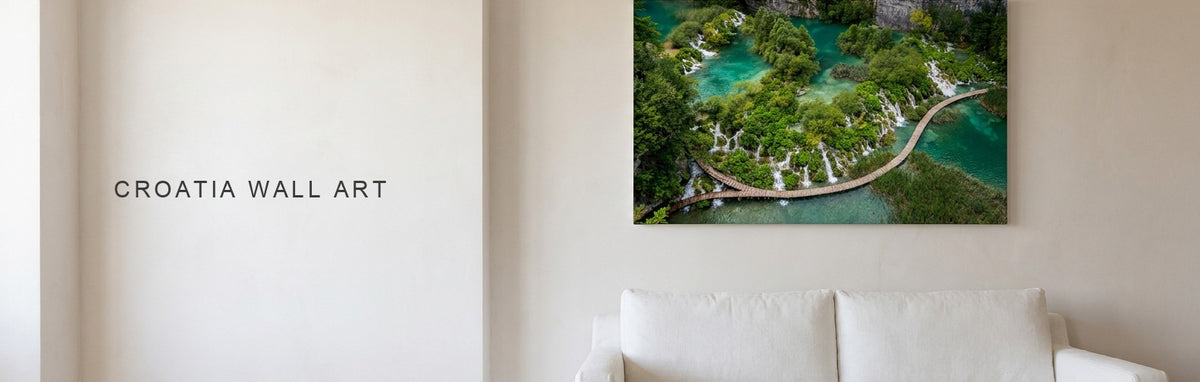
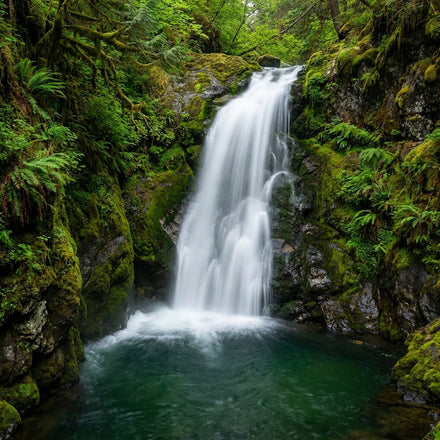
Plitvice Lakes National Park is a chain of sixteen terraced lakes in central Croatia, joined by waterfalls and cascades that spill over natural travertine dams. It became a UNESCO World Heritage Site in 1979. The water color, somewhere between turquoise and emerald, comes from minerals and algae and shifts with the light and the season, which is why no two Plitvice photographs look quite alike.
The range shows it in most of its moods: cascades in summer green, the same falls in autumn orange and gold, a wooden boardwalk path across the water, a single lake enclosed by forest as a vertical. The autumn versions are the warmest and suit a room with wood and ochre; the summer versions are the freshest and suit white or pale green. The broader waterfall wall art range holds the rest of the world's falls, and the choice between silky long exposure water and frozen motion is set out in waterfall wall art, silky water or frozen motion.

Krka is the wider, lower waterfall
Krka National Park, in Dalmatia near Sibenik, has the same travertine geology as Plitvice but a different shape. Its best known fall, Skradinski Buk, is a broad series of cascades rather than a tall drop, so Krka pictures are wide and low with water spreading across the whole frame. They work especially well as horizontal pieces above a long piece of furniture, and there is a small island on the Krka River shown in the range as well.

Dubrovnik, Rovinj and the Adriatic towns
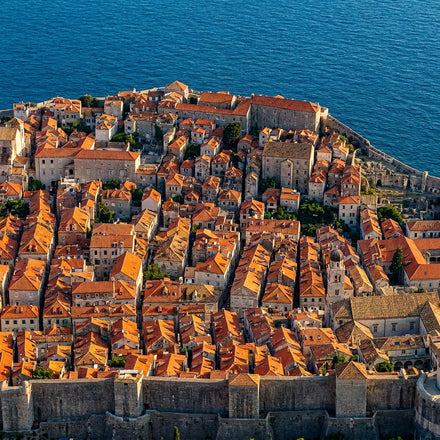
Dubrovnik is the walled city at the southern tip of the country, its Old Town a UNESCO site since 1979, famous for terracotta roofs inside intact stone walls. The range shows it from the harbor, from above, at sunset and with St. John's Fortress guarding the old port. Rovinj, on the Istrian peninsula in the northwest, is the other coastal favorite: a tight hill of pastel houses crowned by the bell tower of the Church of St. Euphemia, photographed here at sunset, at dusk and at blue hour.
Split supplies Diocletian's Palace, the Roman emperor's retirement residence built around the year 300, which still forms the center of the old city. Hvar, Korcula and Zadar add smaller old towns, and the Zlatni Rat beach, known as the Golden Cape, and the islands of Mljet National Park add open sea. These are the pieces to choose for a room that wants warmth and sunlight, and they sit naturally with the wider Mediterranean wall art and coastal wall art ranges.

Zagreb and the flag pieces
Zagreb, the capital, appears in two subjects: the pavilion and fountain in its park squares, and the Croatian National Theater among flowerbeds. The flag pieces show the red, white and blue tricolor with the red and white checkerboard shield, the sahovnica, and the crown of five small shields above it. Those are bought for identity rather than decor, often as a gift for someone with Croatian family.
One flag piece also carries Bitcoin coins, which is a crypto subject rather than a Croatian one, so pass over it if you are after the country.

Which Croatia picture suits which room
| Subject | Palette | Suits |
|---|---|---|
| Plitvice in summer | Turquoise, green, white water | A white or pale green bedroom |
| Plitvice in autumn | Orange, gold, turquoise | A living room with wood and ochre |
| Krka cascades | Green and white, wide and low | Above a long sofa or sideboard |
| Dubrovnik from above | Terracotta, stone, deep blue | A warm living room or dining room |
| Rovinj at blue hour | Blue, violet, warm lights | A study or a darker accent wall |
| Zadar or Plitvice vertical | Varies | A narrow wall or stairwell |
If Croatia is one stop on a bigger Mediterranean wall, the coastal towns pair with the Greek islands and the Italian coast, covered in Greece wall art, blue domes or gold sunsets and Italy wall art, four places, one country. Keep to one palette across the group: terracotta and blue from all three countries hang well together, while a turquoise Plitvice beside a sunset Dubrovnik pulls in two directions.
Quick answers
Common Questions
What art is Croatia known for?
Naive painting, above all the Hlebine school led by Ivan Generalic, whose bright rural scenes painted on the back of glass made Croatian naive art internationally known in the 20th century. Lacemaking from Pag, Lepoglava and Hvar is on the UNESCO intangible heritage list. The canvas range here is photography of Croatian places rather than folk art.
What is Croatia most famous for?
The Adriatic coast and its more than a thousand islands, the walled city of Dubrovnik, Plitvice Lakes National Park, and Diocletian's Palace in Split. Croatia is also credited as the origin of the necktie, from the cravats worn by Croatian soldiers in the 17th century, and of the Dalmatian dog, named for its coastal region.
What is the national flower of Croatia?
The Croatian iris, Iris croatica, is usually named as the national flower. It is a purple iris native to the country's hills and forests. Lavender is the plant most associated with the island of Hvar, whose summer fields are a common subject in travel photography, but it is not an official national symbol.
What are the colors of the Croatian flag?
Red, white and blue in three horizontal stripes, with the national coat of arms in the center. The coat of arms is a red and white checkerboard shield, the sahovnica, topped by a crown of five small shields representing Croatia's historic regions. The flag in its current form was adopted in 1990.
Where is Plitvice Lakes National Park?
Plitvice Lakes National Park is in central Croatia, in the mountainous Lika region near the border with Bosnia and Herzegovina, roughly halfway between Zagreb and Zadar. It is Croatia's oldest and largest national park, protected since 1949, and its sixteen terraced lakes and waterfalls are a UNESCO World Heritage Site.
Shop this guide
The collections in this guide
Every collection this guide mentions. Each one opens on artwork printed to order on museum-quality canvas.

Pieces shown above
The pieces in this guide
Every piece this guide shows, printed to order on museum-quality canvas.
 Plitvice Waterfalls and Turquoise Lakes Canvas Wall ArtFrom $69.95
 Krka River Waterfalls Canvas Wall ArtFrom $69.95
 Dubrovnik Old Town Aerial View Canvas Wall ArtFrom $69.95
 Rovinj Old Town Harbor at Blue Hour Panoramic Canvas Wall ArtFrom $98.95
 Croatian Waving Flag with Coat of Arms Canvas Wall ArtFrom $69.95


Keep reading
Read next
Guides that pick up where this one stops.