

WEDNESDAY SALE! • EXTRA 10% OFF + FREE SHIPPING DEAL | CODE: WEDNESDAY10
WEDNESDAY SALE! • EXTRA 10% OFF + FREE SHIPPING DEAL | CODE: WEDNESDAY10

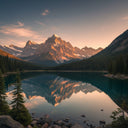
Green wall art in a photograph almost always comes from a landscape. Mountains, forest, lake edge and river bank supply the color, so the shade you get is decided by the subject rather than by a paint chip. Choose the landscape first and the green follows.
That is the opposite of how most color searches are run. People arrive with a swatch and hunt for a match, then find that sage, olive, emerald and forest green each come from a completely different kind of scene.

Sage is dry green. It comes from grassland, olive groves, lichen and old growth at distance, and it reads as a warm neutral rather than a color. Olive sits next to it, slightly deeper and browner.
Emerald and forest green are wet greens. They come from rainforest, moss, tea terraces and water shaded by trees, and they behave as saturated color that a room reacts to. Sage Green Wall Art and Emerald Green Wall Art separate the two, and the sage green guide explains why the pale end behaves as a neutral.

The recurring subjects in this range are mountain valleys, dense forest, still lakes and rivers running through both. Waterfalls appear often because falling water is usually framed by the wettest, greenest vegetation available.
Aurora scenes are the outlier worth knowing about. The green there is light in the sky rather than plant matter, so it sits against black instead of brown and behaves like a night piece. It belongs in a bedroom far more comfortably than a forest scene does. Green Wall Art holds all of these together, and Mountain Wall Art narrows it to peaks.

Not more green. A green artwork on a green wall flattens both unless the two are several steps apart in value, and matching them exactly is the most common mistake made here.
Against sage or olive paint, warm neutrals work: sand, ochre, weathered stone, and black and white photography. Against a deep forest or emerald wall, go lighter and cooler with snow, cloud, water and pale sky. The neutral wall art guide covers the first case and Black and White Wall Art is the reliable answer when a green room already has enough color.

Searches for green walls run into two unrelated products. One is artwork that is green. The other is a vertical garden or preserved moss panel fixed to the wall, which is a plant installation and needs maintenance, mounting and sometimes irrigation.
Everything here is the first kind: photography printed on museum quality canvas with archival inks, stretched over a solid wooden inner frame. It needs a hook and nothing else. If the appeal is the depth and texture of a moss panel, a canvas will not reproduce it, and that is worth knowing before ordering.
Green is the color most consistently read as calm, growth and recovery, which is why it is the standard choice for bedrooms, home offices and any room meant to feel restful. That association is old and cross cultural, and it holds whether the source is a forest or a field.
The practical version is simpler. Green artwork lowers the visual temperature of a room that has a lot of wood, brick or warm paint, and it does that without going cold the way blue does. In a room that already reads cool, a green piece with warm light in it, low sun through trees or autumn edging into the frame, keeps the balance.

Landscape green rewards width, because the subject is usually a valley or a treeline that continues past the frame. In the horizontal range that means 1 Piece, 3 Horizontal, 4 Pop, 5 Star and 5 Pop, from 24 x 16 up to 82 x 42 inches.
Two cautions. A multi panel split across dense forest can read as busy, since the pattern of trunks already breaks the image up, so a single canvas often holds better on woodland than on open water. And a very wide wall is better served by the panoramic range at 36 x 12 to 73 x 24 than by stretching a standard piece. The multi panel comparison works through the trade.
Quick answers
Color collections at canvas print sellers are the practical route, because they let you filter by shade rather than by subject. Tiaracle groups green by shade and by landscape, prints to order on museum quality canvas with archival inks, and offers free shipping with 30 day returns.
Warm neutrals against sage and olive, cool and pale subjects against forest and emerald. Sand, ochre, stone and black and white photography all hold up on a light green wall. Snow, cloud and open water work better on a dark green one. Avoid a green artwork at the same value as the paint.
Growth, renewal and calm, and by extension nature itself. In landscape photography the association is direct rather than symbolic, since the green is literally vegetation. That is why green artwork is a common choice for bedrooms and workspaces, where the intended effect is rest rather than energy.
The color tells you nothing about the product. What matters is how the piece is made and how long it lasts. These are printed to order rather than held in stock, which avoids unsold inventory, and archival inks resist fading so the piece does not need replacing.
Sage is a dry, dusty green that behaves as a warm neutral and sits quietly in a room. Emerald is a saturated wet green that acts as an accent and pulls attention. Sage suits a room you want calm. Emerald suits a room that needs one strong color and has neutral walls to carry it.
Shop this guide
Every collection this guide mentions. Each one opens on artwork printed to order on museum-quality canvas.
Pieces shown above
Every piece this guide shows, printed to order on museum-quality canvas.
Keep reading
Guides that pick up where this one stops.