

WEDNESDAY SALE! • EXTRA 10% OFF + FREE SHIPPING DEAL | CODE: WEDNESDAY10
WEDNESDAY SALE! • EXTRA 10% OFF + FREE SHIPPING DEAL | CODE: WEDNESDAY10

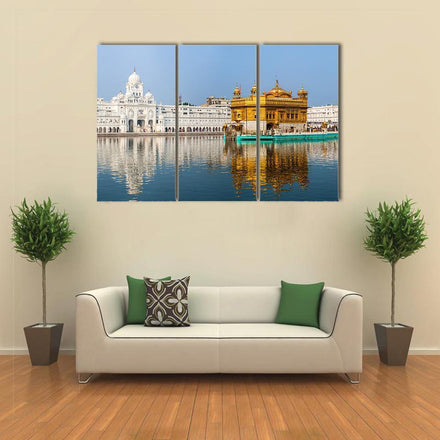
India wall art is dominated by architecture, and by one compositional device in particular: reflection. The Taj Mahal, the Golden Temple and the Jal Mahal are all photographed in still water, which doubles the building and gives the image a symmetry very few subjects offer.

This is not a photographic fashion. It is how the buildings were designed.
Mughal and Rajput architecture placed reflecting pools and lakes in front of major structures deliberately, so the building would appear twice. The Taj Mahal has a formal water channel on its axis. The Golden Temple sits in the middle of a tank. The Jal Mahal stands in a lake.
The practical consequence for a wall is that these images are close to perfectly symmetrical, with the horizon through the center. That makes them behave differently from an ordinary landscape: they are balanced rather than directional, so the eye settles in the middle instead of traveling across.
A symmetrical piece needs to hang straight and centered, the same way a mandala does. Off center above a sofa, the symmetry works against you and the error is obvious.

Marble monuments are the palest group. Taj Mahal in Agra India is white marble against sky, so it carries almost no color and behaves like a neutral.
Sandstone forts and palaces are the warmest. Amber Fort in Jaipur, India and Umaid Bhawan Palace, Jodhpur bring ochre, honey and desert tones, which suit a warm room.
Temples carry the strongest color. Golden Temple Reflections in India is gold on water, and the south Indian temples bring dense carved detail.
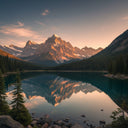
Backwaters and lakes are the quietest. Kerala Houseboat at Sunset and the Dal Lake pieces are green and blue rather than gold, and they read as landscape rather than as monument.

Sandstone, marble, gold and desert dust give this category a consistently warm base, even in the pieces shot at night.
That makes it easy to place in a room built on wood, leather, cream or terracotta, and harder in a cool grey scheme, where the ochre will look out of place rather than complementary.
The Kerala and Kashmir pieces are the exception and the answer if the room is cool. Backwater green and lake blue sit comfortably where a sandstone fort would not.

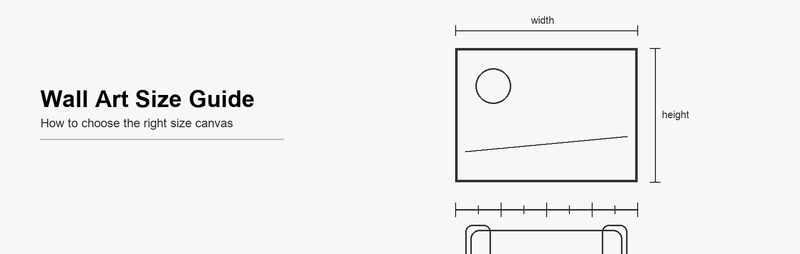
Use the two thirds rule. Artwork above a sofa, bed or console should span roughly two thirds the width of the furniture below it. A standard three seat sofa is about 84 inches wide, so the artwork above it should measure about 56 inches across. Full measurements are in the wall art size guide.
Indian architecture is carved rather than plain, and carving is the first thing lost when a print is small. A temple facade at modest size becomes texture instead of ornament, which throws away the reason to choose it.
Go larger here than you would for a landscape. If the wall cannot take a large piece, choose a marble monument or a backwater scene over a carved temple, since neither depends on fine detail.
Every piece in this collection is offered as a single canvas or as a multi-panel set, chosen on the product page.
Multi-panel works well for the backwaters and the wide lake views, where panel gaps fall into open water.
It works badly for the reflected monuments, and this is the one place the usual advice reverses. A three or five panel split puts a gap either straight down the axis of a symmetrical building or evenly either side of it, and both fight the symmetry that makes the photograph work. Keep the Taj Mahal and the Golden Temple as a single canvas.

A living room takes the marble and backwater pieces easily, and the sandstone forts if the room is warm.
A dining room suits the reflected monuments particularly well, because a symmetrical image above a symmetrical table is a deliberate pairing rather than a coincidence.
A hallway or study suits the carved temple work, since both are places people pass close to and the detail is actually seen.
Start with India Wall Art. For the monuments alongside those of other countries, Landmark Wall Art. For the temple and shrine work as a subject in its own right, Religious Wall Art. For the wider region, Asian Wall Art, and to browse other nations the same way, Countries Wall Art.
For a symmetrical piece above a table, see dining room wall art ideas, and for placing one large piece above furniture, wall art above a bed.
Quick answers
Artwork with India as its subject, dominated by architecture: marble monuments such as the Taj Mahal, sandstone forts and palaces, temples, and the backwaters and lakes of Kerala and Kashmir.
Because they were built that way. Mughal and Rajput architecture placed reflecting pools and lakes in front of major buildings deliberately, so the structure appears twice. The Taj Mahal has a water channel on its axis, the Golden Temple sits in a tank, and the Jal Mahal stands in a lake.
Larger than you would choose for a landscape. Indian architecture is carved rather than plain, and carving is the first detail lost at small sizes. If the wall is small, choose a marble monument or a backwater scene, since neither depends on fine detail.
No. This is the one subject where the usual advice reverses. A panel split puts a gap either down the axis of a symmetrical building or evenly either side of it, and both work against the symmetry that makes the photograph worth having. Keep reflected monuments as a single canvas.
Mostly warm: sandstone ochre, honey, marble white and gold. It suits rooms built on wood, leather, cream or terracotta. If the room is cool grey, the Kerala backwater and Kashmir lake pieces are the ones that will sit comfortably.
Shop this guide
Every collection this guide mentions. Each one opens on artwork printed to order on museum-quality canvas.
Pieces shown above
Every piece this guide shows, printed to order on museum-quality canvas.
Keep reading
Guides that pick up where this one stops.