

THURSDAY SALE! • EXTRA 10% OFF + FREE SHIPPING DEAL | CODE: THURSDAY10
THURSDAY SALE! • EXTRA 10% OFF + FREE SHIPPING DEAL | CODE: THURSDAY10

Japandi wall art sits where Japanese and Scandinavian design overlap: muted palettes, deliberate empty space and natural subjects treated quietly. Both traditions arrived at the same restraint from opposite directions, and the artwork that suits the style is defined more by what it leaves out than by what it shows.
Two traditions that look alike for different reasons.
Japanese design brings wabi-sabi, the acceptance of imperfection and age, plus ma, the idea that empty space is a positive element rather than an absence. Its palette is ink, stone, unfinished wood and paper.
Scandinavian design brings hygge and functionalism: pale wood, white walls, and a preference for things that are useful before they are decorative. Its palette is driven by long dark winters and a need for light.
The overlap is a room that is warm but not cluttered, natural but not rustic. Artwork that fits has to do the same thing, which is why so much Japandi art is fog, stone and bare trees.

If you look at a Japandi mood board, most of the artwork is misty. That is not a coincidence.
Fog does three things at once that the style wants. It removes color, leaving a near neutral palette. It removes detail, so the image becomes shape rather than information. And it creates the empty middle distance that Japanese landscape painting has used for centuries, where a far ridge floats with nothing connecting it to the foreground.
A misty forest photograph is doing, with a camera, what a sumi-e ink wash painting does with a brush. That shared result is why they hang together so comfortably.

Japandi runs on warm greys, off white, oatmeal, black and unfinished wood tones. Nothing is saturated and nothing is pure white.
What breaks it is a single bright accent. The style has no tradition of a feature color, so one saturated piece reads as a mistake rather than as a highlight. If you want warmth, take it from the wood and the textiles, not from the artwork.
The closest safe accent is a muted sage or a soft clay, which is why those two shades appear so often in Japandi rooms. Anything brighter and the room becomes Scandinavian with an accent wall instead.

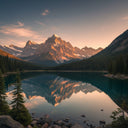
Misty landscapes are the safest choice and the most common. Fog over a lake, a forest road disappearing, mountains fading into haze.
Ink wash and line work brings the Japanese side explicitly. Sumi-e landscapes and single-line botanical studies both belong.
Texture close ups such as sand ripples, weathered stone and bare branches carry wabi-sabi without needing a whole scene.
Single-subject silhouettes work if the background is generous. A lone tree with three quarters of the frame empty is Japandi. The same tree filling the frame is not.
Tiaracle's Japandi Wall Art collection is built around the misty landscape end of this.

Fewer than you think. A gallery wall is the opposite of Japandi, because the style is defined by the space between things.
One large piece per wall is the norm. If you want two, hang them with a generous gap and matching palettes so the pair reads as one considered decision.
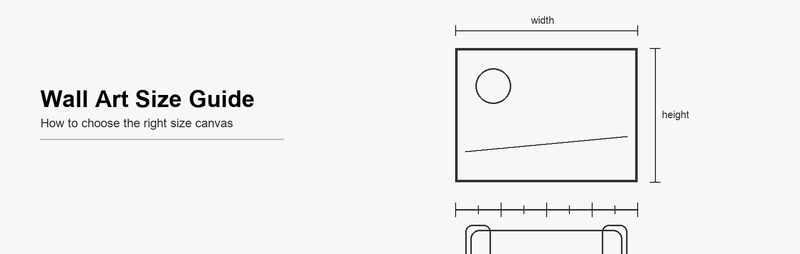
Size to two thirds the width of the furniture below, so about 56 inches above a standard 84 inch three seat sofa. Full measurements are in the wall art size guide.
Hang slightly lower than you would elsewhere. Both parent traditions sit low, with floor cushions, low beds and low tables, so art hung at standard gallery height can float above the room rather than belong to it.

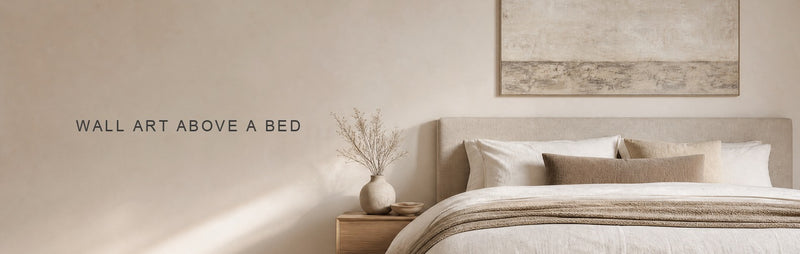
This is where the style is easiest, because a bedroom already wants calm. Misty forest and still water suit a headboard wall, and the muted palette means the piece does not demand attention at night. Placement and fixings are in wall art above a bed.
Start with Japandi Wall Art. For the Japanese side treated as painting rather than photography, Asian Wall Art. For the Scandinavian side, Scandinavian Wall Art. For pieces chosen on emptiness of composition, Minimalist Wall Art, and for the beige and sand palette, Neutral Wall Art.
Quick answers
A hybrid of Japanese and Scandinavian design. It takes wabi-sabi and deliberate empty space from Japan, and pale wood, light and functionalism from Scandinavia. The result is a room that is warm but uncluttered, natural but not rustic.
Warm greys, off white, oatmeal, black and unfinished wood tones. Nothing saturated and nothing pure white. The style has no tradition of a feature color, so a single bright accent piece reads as a mistake rather than a highlight.
Because fog does three things the style wants at once. It removes color, leaving a near neutral palette. It removes detail, so the image becomes shape rather than information. And it creates the empty middle distance that Japanese landscape painting has used for centuries.
Fewer than most styles. One large piece per wall is the norm, because Japandi is defined by the space between things. A gallery wall works against the style. If you hang two, keep a generous gap and match the palettes.
Slightly lower than standard gallery height. Both parent traditions use low furniture, low beds and floor seating, so artwork hung at the usual height can float above the room instead of belonging to it.
Shop this guide
Every collection this guide mentions. Each one opens on artwork printed to order on museum-quality canvas.
Pieces shown above
Every piece this guide shows, printed to order on museum-quality canvas.
Keep reading
Guides that pick up where this one stops.