





Negative Space in Art
Negative space in art is the empty part of a picture, and treating it as a real element rather than as leftover background is what separates a composed image from a snapshot. In artwork on a wall it does something specific: it gives the eye somewhere to rest.
That matters more at large sizes than at small ones, which is why it is worth understanding before buying anything big.
Negative space is a shape, not an absence
The subject of a picture is the positive space. Everything else, the sky, the water, the wall behind, the fog, is negative space. The useful shift is to notice that the empty area has a shape of its own, and that shape is as designed as the subject.
The classic demonstration is the vase that is also two faces: whether you see the object or the gap depends entirely on which one you read as the subject. Once you have seen that, you start noticing the shape of the emptiness in every photograph.

Why it decides whether a big canvas works
A dense image looks impressive as a thumbnail and exhausting at 60 inches. There is nowhere for the eye to stop, so the piece never settles into the room and starts to feel loud after a week.
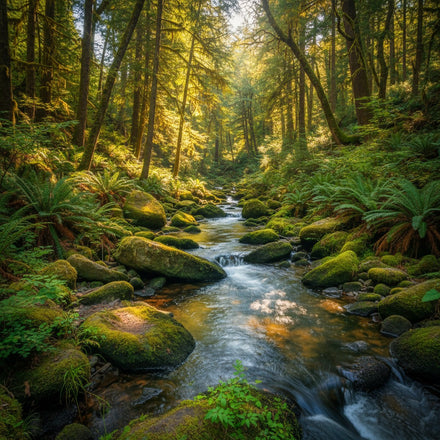
An image with real negative space does the opposite: it gets calmer as it gets bigger, because the empty area grows too. This is the single most useful thing to know when scaling up, and it is why a minimal landscape can carry a whole wall while a busy one cannot. Minimalist Wall Art is where this is most obvious.

What creates it in a photograph
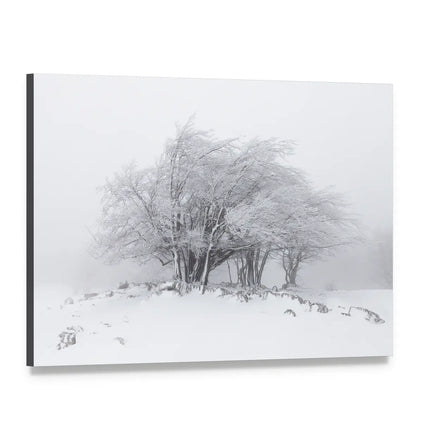
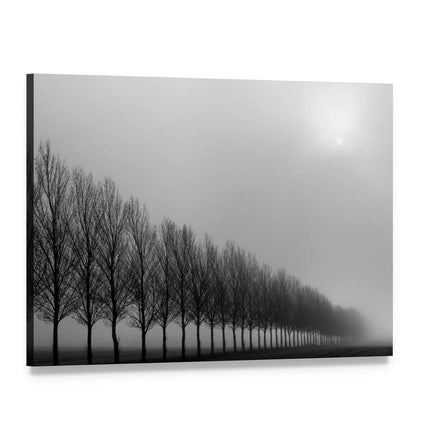
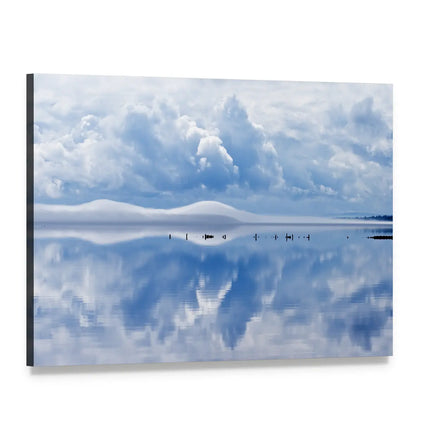
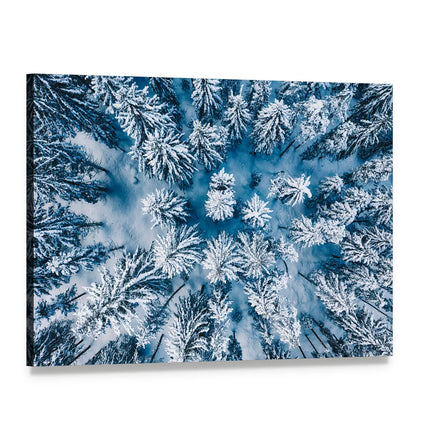
Four things, mostly. Open sky above a low horizon. Still water. Fog or mist, which erases detail without erasing depth. And snow, which does the same thing at higher contrast.
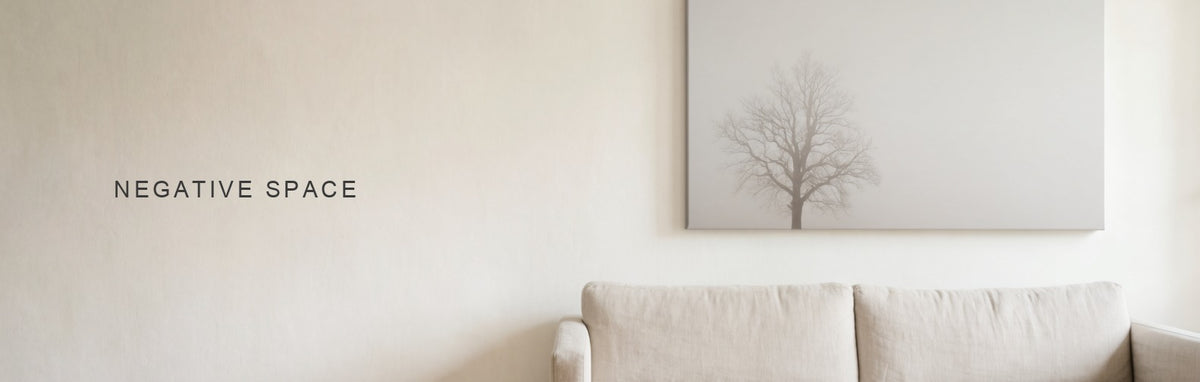
A lone tree in a misty field is the purest version: one small subject, and the rest of the frame doing nothing on purpose. That is why the composition recurs so persistently in landscape work. Nature Wall Art holds most of these.

In abstract work it is deliberate rather than found
A photographer finds negative space; a painter decides it. In abstract work the empty area is placed, which is why the good ones feel balanced in a way that is hard to explain and easy to see.
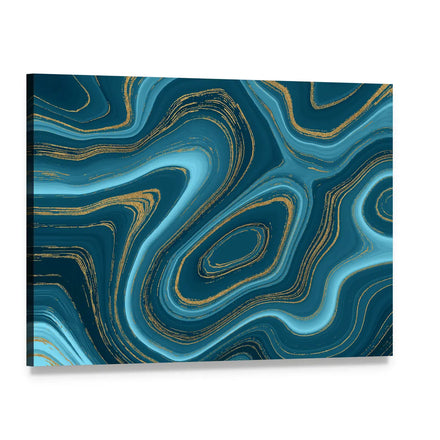
Marble, brushstroke and geometric pieces all use it differently: marble gives large calm areas broken by veining, brushwork gives gaps between marks, and geometric work uses flat ground as a counterweight to the shapes. Abstract Wall Art covers all three.

How to judge it before you buy
Look at the thumbnail and squint until the detail disappears. What remains is the composition: a few large shapes and the gaps between them. If the whole frame goes uniformly grey, there is no negative space and the piece will be busy at size.
The second test is to ask where your eye stops. A well composed image has one place it settles and somewhere quiet to sit around it. If your eye keeps moving, that is a picture to buy small or not at all.

Hanging it, and the space around the frame
Negative space works outside the frame too. A piece with a lot of internal quiet needs wall around it or the two kinds of emptiness compete; a dense piece can sit closer to furniture and other objects without looking crowded.
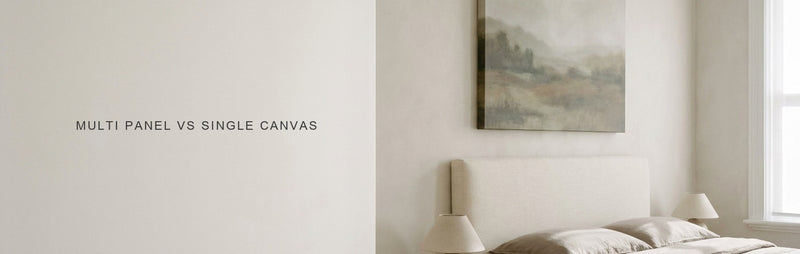
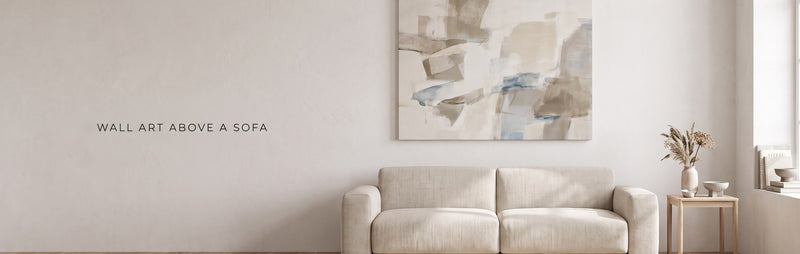
The usual measurements still apply: about two thirds the width of the furniture below, center 57 to 60 inches from the floor. For a minimal subject a single canvas usually beats a split set, because a gap through open sky adds a division the composition did not ask for. The multi panel comparison covers that, and the sofa sizing guide the measurements.
Quick answers
Common Questions
What is negative space in art?
The empty area around and between the subjects. The subject is positive space and everything else is negative, and the useful shift is noticing that the empty part has a shape of its own which is as designed as the subject. The vase that is also two faces is the classic demonstration.
Why does negative space matter for large wall art?
Because a dense image gets louder as it gets bigger and an open one gets calmer. At 60 inches a busy picture leaves the eye nowhere to stop and starts to feel exhausting; a piece with real emptiness scales up comfortably because the quiet area grows with it.
How do I tell if a picture has enough negative space?
Squint at the thumbnail until the detail vanishes. What is left is the composition: a few large shapes and the gaps between them. If the whole frame goes uniformly grey there is no negative space, and the piece will be busy at size.
What subjects have the most negative space?
Open sky above a low horizon, still water, fog or mist, and snow. A lone tree in a misty field is the purest version, with one small subject and the rest of the frame deliberately doing nothing, which is why that composition recurs so often in landscape photography.
Should a minimal image be a single canvas or a split set?
Usually a single canvas. A gap falling through open sky introduces a division the composition never asked for, whereas a busy image with detail spread evenly loses nothing to the seams. The emptiness is the point, so leave it uninterrupted.
Shop this guide
The collections in this guide
Every collection this guide mentions. Each one opens on artwork printed to order on museum-quality canvas.


Pieces shown above
The pieces in this guide
Every piece this guide shows, printed to order on museum-quality canvas.
Keep reading
Read next
Guides that pick up where this one stops.