

WEDNESDAY SALE! • EXTRA 10% OFF + FREE SHIPPING DEAL | CODE: WEDNESDAY10
WEDNESDAY SALE! • EXTRA 10% OFF + FREE SHIPPING DEAL | CODE: WEDNESDAY10

Office wall decor ideas usually start with style. Start instead with one constraint no other room has: the art appears in your video calls. That single fact decides more than style does, because a piece chosen to look good in the room can read as noise on camera at 720 pixels.
Start with what sits behind your chair, then work outward to the rest of the walls.

Anything directly behind your head is compressed, softened and cropped by a webcam. Fine detail turns to mush, busy images become texture, and text becomes unreadable in a way that draws the eye more than it would in person.
What survives is simple shapes and clear contrast: a single strong subject, a wide landscape with a clean horizon, an abstract with a few large forms. What fails is a dense city scene or a gallery wall of small frames. Office Wall Decor holds the range and Minimalist Wall Art the simplest end of it.

A city skyline is the single most frequent piece in this category. It reads as professional without being corporate, it carries no personal statement, and its horizontal shape matches the wall above a desk almost exactly.
A night skyline also solves the camera problem neatly: lit windows against a dark sky is high contrast and low detail, which is what a webcam handles well. City Wall Art covers the wider range.

World maps, embossed globes and similar pieces are the second recurring theme, and they work for the same reason skylines do: instantly legible, no personal claim, and a shape that suits a wide wall.
They also give a room a sense of reach without saying anything specific about the business, which is why they turn up in so many offices that have nothing else in common.

Alongside the general pieces there are subjects bought for one kind of room: a dental x-ray for a practice, oilfield machinery for an energy office, legal or medical subjects for the relevant firm. These are not decoration in the usual sense.
If you are furnishing a working office rather than a study, that specificity is usually what you want. A piece that names the business does more for a waiting area than a landscape does. Medical Wall Art and Oilfield Wall Art are two of those.
An office has less usable wall than it looks. The desk takes one wall, shelving usually takes another, and the door and window take most of what is left, so the real decision is often between one good wall and nothing.
Above the desk is the default and it works, but the piece needs to clear a monitor: measure from the top of the screen, not from the desk. The wall opposite the desk is the underrated option, because it is what you actually look at while thinking, and it is the only wall in the room you see for hours at a time.

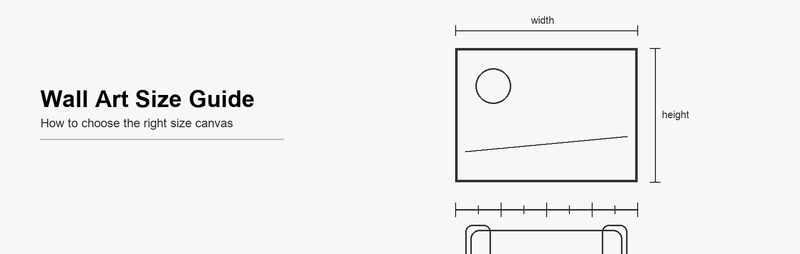
The two thirds rule still applies but the reference object is the desk, not the room: about two thirds the desk width, so roughly 40 inches above a 60 inch desk. Center 57 to 60 inches from the floor as usual, unless a monitor forces it higher, in which case clear the screen by at least 6 inches and accept the piece sits high.
Horizontal work runs 1 Piece, 3 Horizontal, 4 Pop, 5 Star and 5 Pop from 24 x 16 to 82 x 42 inches, and panoramic covers 36 x 12 to 73 x 24, which suits the narrow strip above a monitor better than anything else. The sizing guide covers the method and the size guide the full range.
Quick answers
Something that survives a webcam if it sits behind you: simple shapes and clear contrast, such as a night skyline, a wide landscape with a clean horizon, or an abstract with a few large forms. Dense city scenes and grids of small frames turn to texture on camera.
About two thirds the desk width, so roughly 40 inches above a 60 inch desk. Center 57 to 60 inches from the floor, unless a monitor forces it higher, in which case clear the top of the screen by at least 6 inches. Measure from the monitor, not the desk surface.
Both, for different reasons. Behind you it is seen by other people on calls and needs to be simple. Opposite you it is what you actually look at for hours, and it is the underrated wall in most offices because nobody thinks to use it.
Rarely, and it is the most common choice for good reasons: legible, impersonal, horizontal, and high contrast at night so it reads well on camera. If it feels too neutral, a map or a landscape with a strong horizon does the same job with a different tone.
Something specific to the work. This range includes subjects bought for one kind of room, from medical imagery to oilfield machinery, and in a waiting area a piece that names the business does more than a general landscape. That specificity is the point rather than a limitation.
Shop this guide
Every collection this guide mentions. Each one opens on artwork printed to order on museum-quality canvas.
Pieces shown above
Every piece this guide shows, printed to order on museum-quality canvas.
Keep reading
Guides that pick up where this one stops.