

MONDAY SALE! • EXTRA 10% OFF + FREE SHIPPING DEAL | CODE: MONDAY10
MONDAY SALE! • EXTRA 10% OFF + FREE SHIPPING DEAL | CODE: MONDAY10

Paris wall art has a default, and it is black and white. Nearly every result for the term is a monochrome Eiffel Tower. That version is a neutral graphic choice. The alternative, Paris photographed in color at golden hour or after dark, is a warmer piece that behaves completely differently on a wall.
Search the term and the pattern is unmistakable. Sepia and black and white Eiffel Towers, monochrome views from the Seine, framed sets of three in grayscale, and at least one shop ranking on a page devoted entirely to black and white Paris.
There is a reason it dominates. Stripped of color, the Eiffel Tower becomes a shape rather than a scene. It reads as graphic pattern, it carries no temperature, and it drops into any palette without argument. That is genuinely useful, and it is why the look became standard.
It is also why so many Paris walls look alike. Nothing here is black and white, which is a deliberate limit rather than an oversight, and the rest of this page is about what the color version does instead.

Photographed as the sun drops, Parisian limestone turns honey and amber. The city is built almost entirely from one pale stone, so at that hour the whole frame warms at once rather than just the sky.
Eiffel Tower at Sunset Over Paris is that picture. On a wall it behaves like a warm piece, not a travel photograph. It sits with wood, brass, leather and cream, and it fights a cool gray or navy room in the way any warm image does.
This is the actual decision, and it is not really about Paris. Monochrome is a neutral that goes anywhere. Color at golden hour is a commitment to a warm scheme.

After dark the city becomes points of light on a dark ground, which is close to the tonal behavior of a black and white piece while keeping color in it.
The frame is mostly deep blue and near black, with warm lamplight and the tower illumination doing the work. It is dark enough to sit in a room with dark walls, and quiet enough not to compete, which makes it the most forgiving of the three in an interior that is already busy.

Roughly half the pieces here show the Eiffel Tower, which is what people search for. The consequence is that the difference between two Paris canvases is usually the vantage point rather than the subject.
From the Seine, as in Eiffel Tower from Seine River, the tower sits behind water and bridges, so the picture is a river scene with a landmark in it. It has depth and it reads calm.
From below, as in Internal Structure of the Eiffel Tower, the ironwork fills the frame and the picture becomes near abstract pattern. This is the version that suits a modern room, because it reads as geometry first and landmark second.
Across the rooftops, as in Paris Cityscape, the tower is one element in a wide view of zinc roofs and chimneys. That version needs width to work.

The rest of the subject is bridges and cathedral. Alexandre III Bridge in Paris is the most ornate crossing in the city, gilded and lamp lined, and it makes a strong piece precisely because it is not the obvious choice.
Notre Dame and the Seine bridges make up most of the remainder. Street and cafe scenes are the smallest group here, which is worth knowing if a Parisian street cafe is the specific picture in mind.

A rooftop cityscape or a river view needs width, so a panoramic format at up to 60 by 20 inches on a single canvas usually suits it better than a scaled up rectangle. The tower photographed from below is the opposite case: the subject is tall, so a vertical format from 12 by 24 up to 24 by 48 inches lets the ironwork run.
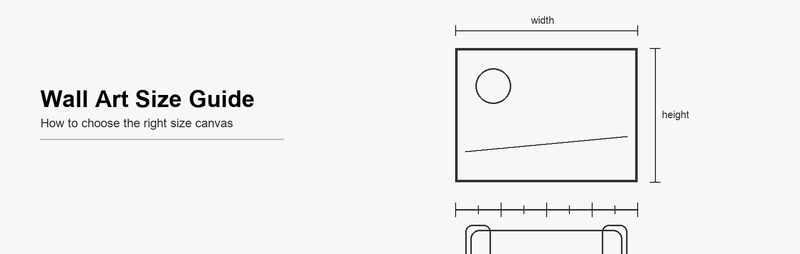
Over a sofa or console, span roughly two thirds the furniture width with a six to eight inch gap above. Full measurements are in the wall art size guide, and the case for scaling up on a wide wall is in large wall art guide.
Start with Paris Wall Art, and for the wider country including the coast, the Alps and the countryside, France Wall Art.
For the golden hour version specifically, Sunset Wall Art. For a rooftop view across a wide wall, Panoramic Wall Art, and for the same treatment applied to other skylines, City Wall Art.
For another European subject where the same warm and cool choice decides the room, see greece wall art, blue domes or gold sunsets.
Every piece is printed to order on museum-quality canvas with archival inks that resist fading, stretched over a solid wooden inner frame and delivered ready to hang.
Quick answers
Because monochrome turns the Eiffel Tower into a shape rather than a scene. It carries no color temperature, so it drops into any palette without clashing. That makes it the safe default, and it is also why so many Paris walls look the same.
Golden hour versions do not, since Parisian limestone photographs honey and amber and reads as a warm piece. Night scenes do, because after dark the frame is mostly deep blue and near black with only small points of warm light in it.
It depends on the room rather than the view. From the Seine gives depth and calm and reads as a river scene. From directly below fills the frame with ironwork and reads as geometry, which suits a modern interior. Across the rooftops needs a wide wall.
Match the format to the vantage point. Rooftop and river views want width, up to 60 by 20 inches on a single panoramic canvas. The tower shot from below wants height, 12 by 24 up to 24 by 48 inches. Over furniture, span about two thirds its width.
Bridges and cathedral, mostly. The Alexandre III bridge is the most ornate crossing in the city and makes a strong piece precisely because it is not the expected image. Notre Dame and the Seine bridges make up most of the rest.
Shop this guide
Every collection this guide mentions. Each one opens on artwork printed to order on museum-quality canvas.
Pieces shown above
Every piece this guide shows, printed to order on museum-quality canvas.
Keep reading
Guides that pick up where this one stops.