MONDAY SALE! • EXTRA 10% OFF + FREE SHIPPING DEAL | CODE: MONDAY10
MONDAY SALE! • EXTRA 10% OFF + FREE SHIPPING DEAL | CODE: MONDAY10

The Starry Night is an oil painting Vincent van Gogh made in June 1889, showing a swirling night sky over a quiet village with a dark cypress in the foreground. He painted it from the east-facing window of his room at the Saint-Paul-de-Mausole asylum in Saint-Remy-de-Provence. It has hung in the Museum of Modern Art in New York since 1941.
It is one of the most reproduced images in the world, and most of what people remember about it is slightly wrong. Van Gogh did not paint it outdoors at night. He did not consider it a success. The village below is not really the village he could see.
The essentials, in one place:
Van Gogh had admitted himself to the asylum in May 1889, after the breakdown in Arles the previous December. He was given a room with a view east over the valley, and a separate room to use as a studio. The Starry Night comes from that period, roughly thirteen months before his death in July 1890.
From the window of his room at the asylum, looking east just before sunrise. Van Gogh described the view in letters to his brother Theo, including the morning star hanging large over the hills.
But the painting is not a record of that view. He worked on it in his studio during the day, from memory and from studies, not standing at the window at night. That matters, because it explains why the sky behaves the way it does. He was not copying what was in front of him.
The hills in the distance are the Alpilles, which he really could see. The village is not. There was no village in that view, and the church spire is narrow and steep in a way that belongs more to the Dutch churches of his childhood than to Provence. He assembled the scene rather than transcribed it.

Three bands, read from the bottom up.
The village. A small settlement of simple houses with lit windows, low and orderly, with the church spire rising in the middle. It is the calmest part of the painting and the only part that is clearly still.
The cypress. The dark flame-shaped tree in the left foreground, much closer to the viewer than anything else and running from the bottom edge almost to the top. Cypresses grow in Provencal graveyards, and Van Gogh painted them repeatedly in this period. He wrote to Theo that he found them beautiful in line and proportion, and difficult to get right.
The sky. Eleven stars, a crescent moon at the right, and a large bright body near the cypress that is commonly identified as Venus, the morning star he mentioned seeing. Two great curves of cloud or wind roll through the middle. The sky takes up roughly three quarters of the canvas.
Partly the image and partly the story, and it is worth separating them.
The image itself does something unusual. Most night paintings are dark. This one is bright, and it is bright because Van Gogh painted the sky in thick strokes of pale yellow and white against blue rather than washing it in black. The paint is applied heavily enough that the brushwork itself is visible as texture, so the sky reads as moving.
The story is that it was painted in an asylum by a man who died a year later, and that framing has followed the painting since. Treat it carefully. It has led to a great deal of confident writing about what the swirls prove about his mental state, and none of that is established. What can be said is that he was unwell, that he knew it, and that he was working steadily and deliberately throughout.
Its position at the Museum of Modern Art from 1941 onward did the rest. A permanent place in one of the most visited modern collections in the world is its own kind of fame.
The Starry Night is one of roughly 150 paintings from a single year at the asylum, between May 1889 and May 1890. It was among the most productive stretches of his life, which is worth stating plainly because the asylum period is usually described as a decline.
The recurring subjects from those months are the ones visible from the grounds and the window: cypresses, olive groves, wheatfields with the Alpilles behind them, and irises in the garden. He also made painted copies after prints by other artists, including Millet, as a way of working when he could not go outside.
Two points follow from this that change how the painting reads. The cypress in The Starry Night is not a symbol he reached for once; it is a form he was studying continuously across that year. And the swirling sky was made in a period of sustained, organized output, not in a single disordered night.
No. He was dismissive of it. In letters to Theo he grouped it with work he considered unsuccessful, and referred to it as a failure.
This is one of the more useful facts about the painting, because it cuts against the way it is usually presented. The picture now used as shorthand for artistic genius was, to the man who made it, an experiment that did not come off. He was more satisfied with his studies of cypresses and wheatfields from the same months.
They are two different paintings, and this is the most common mix-up around Van Gogh's night work.
The Starry Night, June 1889, painted at Saint-Remy-de-Provence, held at the Museum of Modern Art in New York. This is the one with the swirling sky, the cypress and the village.
Starry Night Over the Rhone, September 1888, painted at Arles about nine months earlier, held at the Musee d'Orsay in Paris. It is a calm riverside scene: the Rhone at night, gas lights along the far bank throwing long reflections down the water, the stars of the Great Bear overhead, and a couple walking in the foreground. Oil on canvas, 72.5 by 92 centimetres.
A third night painting from the same Arles period is Cafe Terrace at Night, also September 1888, held at the Kroller-Muller Museum in the Netherlands.
If you are buying a print and the listing simply says "Starry Night", check the image. The Rhone painting is horizontal and calm with a strong band of reflected light across the water. The MoMA painting has the cypress on the left and the sky in motion. They are not interchangeable and they suit very different rooms.
Thickly, and fast, which is what gives the surface its character.
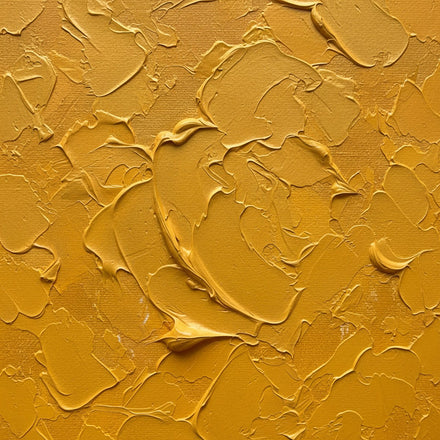
Van Gogh worked in impasto, meaning paint applied heavily enough to stand proud of the canvas rather than soak into it. In The Starry Night the strokes in the sky are laid down in visible ridges that follow the direction of the curves, so the movement you read in the sky is partly literal: the paint physically travels that way.
Much of it was worked wet into wet, one loaded stroke placed against another before the first had dried, which is why the blues and yellows sit beside each other cleanly instead of blending into green. That restraint is deliberate and it is harder than it looks.
The practical consequence for a reproduction is that the texture is half the painting. A flat matte poster loses it. Canvas keeps a woven surface that catches light in a way that reads closer to the original, which is the main reason this particular image is so commonly sold as a canvas rather than as paper.

A narrow palette, which is part of why it holds together.
The sky runs through ultramarine and cobalt blue, with the stars and moon in chrome yellow and white. The village uses the same blues with small warm yellow windows. The cypress is a deep green so dark it reads as near-black against the sky.
The whole painting is essentially blue and yellow, which sit opposite each other in warmth and make each other look stronger. If you are matching a print to a room, that is the practical takeaway: it is a blue painting with yellow accents, and it will sit with either.

Two things are worth knowing before buying any reproduction of it.
The first is proportion. The original is wider than it is tall, close to 4:5 in height to width. Reproductions that crop it to a square or a tall portrait shape cut the sky or lose the cypress, and both are load-bearing parts of the composition.
The second is that the appeal is the brushwork, so the surface matters. On canvas the texture of the weave sits closer to the impasto of the original than a flat paper print does.
Tiaracle's Vincent Van Gogh Starry Night 1889 canvas is printed to order on museum-quality canvas with archival inks, stretched over a solid wooden inner frame and shipped ready to hang. It is available as a single piece or as a multi-panel set.
If it is the night sky itself that draws you rather than the painting, the astronomy wall art collection covers stars, moons and deep space. For the palette rather than the subject, see blue wall art and yellow wall art. For scale on a large wall, large wall art covers the sizing.

It is a dark, high-contrast, blue-dominant image, and that narrows the sensible options more than most prints do.
It needs a light wall. On a dark or navy wall the sky loses its glow, because the effect depends on the bright sky reading against something paler. White, off-white and warm neutral walls all work.
It needs distance. The brushwork resolves into a scene from across a room and dissolves into abstract strokes up close. That makes it a good fit for a living room, a stairwell landing or a wall you view from six feet or more, and a poor fit for a narrow corridor where you only ever see it at arm's length.
It is busy, so give it space. This is not a piece for a crowded gallery wall. It works as a single anchor with clear wall around it. If you hang it above a sofa, follow the usual rule of about two thirds of the sofa width and 8 to 10 inches of gap above the back.
Watch the light. Strong direct sunlight across any print is worth avoiding. Tiaracle prints with archival inks that resist fading, but no print benefits from hours of direct sun.
For the other picture in this series, see The Great Wave off Kanagawa explained; for the line, color and texture the painting is built from, the 7 elements of art guide.
Yes. Van Gogh died in 1890 and the painting dates from 1889, so the work itself is long out of copyright and can be reproduced freely. That is why it appears on so many products from so many sellers.
Two caveats worth knowing before you order. A specific photograph or scan of a painting can carry its own rights even when the painting does not, which is why reproduction quality varies so widely between sellers working from different source files. And public domain says nothing about print quality: the same image printed on thin paper and on museum-quality canvas with archival inks are very different objects.
Practically, it means judge a Starry Night print on the source image and the material, not on licensing. Nobody has exclusive rights to sell it.
The Museum of Modern Art, 11 West 53rd Street, New York. It is part of the permanent collection rather than a touring work, so it is normally on view, though any museum can move a painting for conservation or loan. Check before traveling for it specifically.
It is not in the Van Gogh Museum in Amsterdam, which is the most common mistaken assumption. That museum holds the largest Van Gogh collection in the world, including Sunflowers and The Bedroom, but not this painting.
Quick answers
The Museum of Modern Art in New York, where it has been since 1941. It is part of the permanent collection and normally on public view. It is not in the Van Gogh Museum in Amsterdam, which is the usual assumption.
No. He painted it during the day in his studio at the Saint-Paul-de-Mausole asylum, working from memory and earlier studies rather than at the window in darkness. The view was real, looking east over the Alpilles, but the painting was assembled rather than observed directly, and the village below was invented.
73.7 by 92.1 centimetres, about 29 by 36 inches, in oil on canvas. It is a landscape format, wider than it is tall, which is worth knowing when choosing a reproduction, since square or portrait crops cut into either the sky or the cypress.
Van Gogh never wrote an explanation, so every reading is an interpretation. The most cited ones are the contrast between the turbulent sky and the still village, the cypress as a link between earth and heaven, and the painting as a record of what he saw and felt from the asylum window at Saint-Remy in June 1889.
The original is 29 by 36 inches, and a print close to that size reads as a picture rather than a poster. Above a sofa a single canvas at 36 by 24 or 48 by 32 inches works; on a smaller wall 24 by 16 does. The swirling sky loses its rhythm when it is printed very small, so this is one to size up on.
Shop this guide
Every collection this guide mentions. Each one opens on artwork printed to order on museum-quality canvas.
Pieces shown above
Every piece this guide shows, printed to order on museum-quality canvas.
Keep reading
Guides that pick up where this one stops.