

TUESDAY SALE! • EXTRA 10% OFF + FREE SHIPPING DEAL | CODE: TUESDAY10
TUESDAY SALE! • EXTRA 10% OFF + FREE SHIPPING DEAL | CODE: TUESDAY10

The Great Wave off Kanagawa is a Japanese woodblock print made by Katsushika Hokusai around 1831, showing a towering wave about to break over three boats with Mount Fuji small in the distance. Its proper title is Under the Wave off Kanagawa, and it is the first print in his series Thirty-six Views of Mount Fuji.
Two things surprise most people about it. It is not a painting, and there is no single original. Both facts change how you should think about buying a copy.
Hokusai was around seventy when he made it, already decades into his career. It was not an early breakthrough; it came late, from an artist who had been working since his teens.
Because it is a print, not a unique object.
A woodblock print is made by carving blocks, one per color, and pressing sheets against them. The design can be printed repeatedly, and this one was. Estimates of the original edition run into the thousands, with impressions produced over years as demand continued.
So when a museum displays The Great Wave, it is showing one impression from that edition, not the original. Several major museums hold one, which is why you can see it in New York, London and Chicago rather than having to travel to a single place.
Impressions do differ. The blocks wore down with use, so later pulls show softer lines than early ones, and colors vary between printings. Among specialists, an early impression is worth considerably more than a late one, which is a distinction that does not exist for a painting.

Almost certainly not, despite how often it is described that way.
A tsunami is generated by seismic activity and behaves differently in open water, where it is barely noticeable, only rising as it approaches shore. What Hokusai drew is a large storm or rogue wave in open sea, with the boats still well offshore.
The Japanese title supports this. It uses okinami, meaning an offshore wave, rather than any word for a seismic sea wave. The tsunami reading is a later import, and it is worth correcting because it changes what the image is about: not a disaster, but working boats caught in rough water.
They are oshiokuri-bune, fast rowed boats used to carry live fish from the outer islands to the markets of Edo, now Tokyo. Each carries a crew of eight, with two more figures in the bow, and they are gripping the hull as the wave rises.
This matters to how the picture reads. These are not tourists or fishermen caught out by accident. They are couriers doing a routine, dangerous job on a known route, and the wave is an occupational hazard rather than an event. The men are bent to the boat, not looking up at it.

In the center, low, in the trough between the waves, and it is easy to miss on first look.
Fuji is the thread running through Hokusai's series and through Japanese landscape imagery generally, which is why it appears in about a quarter of our Japanese wall art.
This is the cleverest thing in the composition. Fuji is the actual subject of the series, and Hokusai puts it in the distance where the near wave briefly dwarfs it. The white foam at the wave's crest and the snow on Fuji's peak rhyme with each other, so your eye moves between them.
The joke, if it is one, is about scale and permanence. The wave looks enormous and will be gone in seconds. The mountain looks small and has been there for the whole of human history.
Prussian blue, a synthetic pigment that reached Japan through imported goods not long before the print was made.
Japanese printmakers had previously relied on plant-based blues that faded badly. Prussian blue was deeper, more stable and held its color, and its arrival is part of why this series looks the way it does. Hokusai used it heavily and the print is built around it.
So the color that now reads as characteristically Japanese was, at the time, a new imported material being tried out. That is worth knowing if you are matching a reproduction to a room: the piece is essentially a study in one blue against off-white, which makes it unusually easy to place.
A series of landscape prints showing the mountain from different places, in different weather, at different distances. Despite the name it eventually ran to forty-six prints, because ten more were added after the first set sold well.
The premise is the constant. Fuji appears in every one, but it is rarely the thing the picture is about. It sits behind carpenters at work, behind travellers on a road, behind a wave. The mountain is the fixed point and ordinary life happens in front of it.
Two other prints from the series are widely known. Fine Wind, Clear Morning, usually called Red Fuji, shows the bare mountain turning red at dawn with no human figures at all. Thunderstorm Beneath the Summit shows lightning striking low on the slopes while the peak stays clear above the weather.
Seeing The Great Wave as one of a set changes it. On its own it looks like a picture of a wave. In the series it is a picture of Mount Fuji that happens to have a wave in front of it.
A Japanese artist who worked for roughly seventy years and produced an enormous body of work, of which The Great Wave is one sheet.
He changed his professional name repeatedly across his career, which was normal practice at the time and makes his output harder to track than a Western painter's. He also produced the Hokusai Manga, a set of sketchbooks running to thousands of drawings of figures, animals, landscapes and everyday objects, made partly as instructional material.
He is often quoted as saying that nothing he made before the age of seventy was of any value, and that he expected to be getting somewhere by ninety. Whether or not the wording is exact, the sentiment fits the record: The Great Wave was made in his seventies and he was still working in his late eighties.
He is also part of why European art looks the way it does after the 1860s. When Japanese prints reached Europe they were studied closely by artists including Van Gogh and Monet, and the flat color, high viewpoints and cropped compositions fed directly into Impressionism and what followed. The two most reproduced images in this article, this one and The Starry Night, are connected by that influence.
Yes. Hokusai died in 1849 and the work dates from the 1830s, so the design is long out of copyright and can be reproduced freely.
The usual caveat applies. A specific modern photograph or scan of a particular impression can carry its own rights even though the design does not, which is why reproduction quality varies so much between sellers working from different source files. Judge a print on the source image and the material rather than on any claim of exclusivity, because nobody holds exclusive rights to it.

Three things are worth checking on any reproduction.
Proportion. The original sheet is a horizontal rectangle, roughly 2:3. Crops to a square lose either the boats on the left or the falling water on the right, and both carry the composition.
The blue. Reproductions vary widely, and many push the blue towards a modern cyan that the original does not have. Prussian blue is deep and slightly muted rather than bright.
Line quality. The design depends on crisp outlines, particularly in the claws of foam. A low-resolution source goes soft there first, and it is the most visible failure in a poor copy.
Whether to split it across panels. Most famous paintings lose something when divided, because the gaps cut through a composition built as one rectangle. This one is an exception. The design already moves left to right, from the boats under the curl through the trough to the falling water, so panel divisions land between those elements rather than through a face or a focal point. A three-panel split reads as three moments of the same wave. If you were ever going to split a famous image, this is the one that takes it best.
Tiaracle's Hokusai Wave canvas is printed to order on museum-quality canvas with archival inks, stretched over a solid wooden inner frame and shipped ready to hang, available as a single piece or split across panels. The horizontal composition suits the multi-panel treatment unusually well, since the wave already reads left to right.
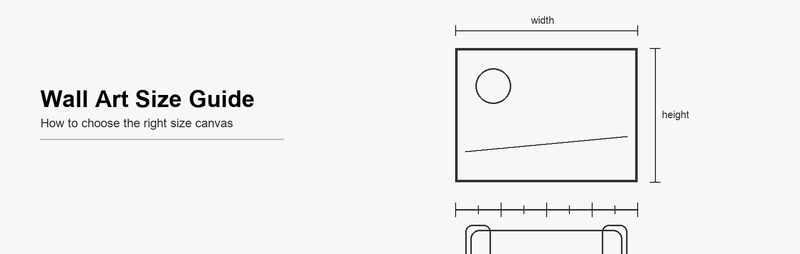
For related subjects, see ocean wall art and sea wall art, or blue wall art for the palette. If you are working out sizing first, the wall art size guide covers it, and The Starry Night explained covers the other most reproduced image in the world.
By four people, not one, which is another reason the word original is slippery here.
The artist drew the design. A block cutter carved it into cherry wood, destroying the original drawing in the process, since it was pasted face down onto the block and cut through. A printer inked the blocks and pressed the paper by hand, using a separate block for each color and registration marks to keep them aligned. A publisher commissioned and financed the whole thing and took the commercial risk.
The Great Wave needed multiple blocks and multiple passes for every sheet, each one aligned by eye and hand. Any misalignment shows immediately in the outlines, which is one way specialists judge the quality of a given impression.
This also explains the economics. These were commercial products, not luxury goods. A print like this sold for roughly the price of a bowl of noodles, which is worth holding in mind against its status now. It was made to be affordable and widely distributed, and reproducing it cheaply on a wall today is closer to its original purpose than hanging it in a vault would be.
Three reasons that reinforce each other.
It reads at any size. The design is built from large simple shapes and strong outlines, so it survives being shrunk to a phone case or blown up to a wall. Most paintings do not.
It is legible instantly. A wave, boats, a mountain. There is no story you need to know first, no religious or historical context to decode, which is not true of most equally famous images.
It is free to use. Being out of copyright means anyone can print it, so it appears on everything, which raises recognition, which increases demand. That loop has been running for over a century.
The result is an image most people can describe without knowing the artist's name, the title, or that it is a print rather than a painting.

It is a horizontal, high-contrast, single-color image, which makes it more flexible than most famous artworks.
The proportions suit a wide wall: above a sofa, above a bed, or along a hallway where the left to right movement works with the direction you walk. On a narrow vertical wall it fights the space.
It also sits comfortably in rooms where a European oil painting would look out of place. The flat color and graphic outline read as modern, so it works in minimal and contemporary interiors as easily as traditional ones. Against a white or warm neutral wall the blue carries the room without needing anything else.
Quick answers
No, it is a woodblock print. Hokusai designed it and carvers and printers produced it from carved blocks, one per color. That is why thousands of impressions exist and why several museums each hold one, rather than there being a single original in one place.
Almost certainly not. The Japanese title uses okinami, an offshore wave, and a tsunami is barely perceptible in open water, only rising near shore. What is shown is a large storm or rogue wave in open sea with the boats still well offshore, so the tsunami description is a later misreading.
Mount Fuji, sitting low in the center of the image in the trough between waves. It is the actual subject of the series the print belongs to, Thirty-six Views of Mount Fuji, and Hokusai deliberately places it small and distant so the nearer wave appears to tower over it.
On a wall with cool or neutral color around it and enough width for the wave to move. It is a horizontal image, so it suits the wall above a sofa, a console or a bed. The Prussian blue reads well against white, pale grey and warm wood, and badly against a saturated wall that competes with it.
The original woodblock print is small, about 10 by 15 inches, the standard oban sheet of its day. Modern prints are made far larger, and the image holds up at 36 by 24 or 48 by 32 inches because it was designed in bold flat shapes rather than fine detail. Keep the proportion close to 3 by 2.
Shop this guide
Every collection this guide mentions. Each one opens on artwork printed to order on museum-quality canvas.
Pieces shown above
Every piece this guide shows, printed to order on museum-quality canvas.
Keep reading
Guides that pick up where this one stops.