

FRIDAY SALE! • EXTRA 10% OFF + FREE SHIPPING DEAL | CODE: FRIDAY10
FRIDAY SALE! • EXTRA 10% OFF + FREE SHIPPING DEAL | CODE: FRIDAY10
Japanese wall art brings the subjects Japan is photographed for onto a wall: Mount Fuji, temple roofs against autumn maples, bamboo groves, still lake reflections and the neon depth of Tokyo at night. This collection is built from photographs taken in Japan and of Japanese subjects, chosen by hand rather than swept up by keyword.
Mount Fuji appears in roughly a quarter of the collection. Temples, shrines and pagodas account for about 13 percent, city skylines about 20 percent, autumn foliage about 9 percent, and gardens about 7 percent. Cherry blossom, bamboo, castles and traditional bridges run through the rest.
Two different things get sold under this name, and they suit different rooms.
Traditional Japanese art means the woodblock tradition: ukiyo-e prints, Hokusai and Hiroshige, flat color, bold outline and stylized waves and mountains. It reads as graphic and historical.
Japanese photography and landscape means the country itself: Fuji at dawn, a torii gate standing in water, snow on a temple roof, a bamboo path. It reads as calm, atmospheric and contemporary, and it is what this collection holds.
The distinction matters because the two behave differently on a wall. Woodblock work is high contrast and demands attention. Photographic Japanese landscape is tonal and quiet, which is why it suits bedrooms, hallways and rooms already busy with pattern.
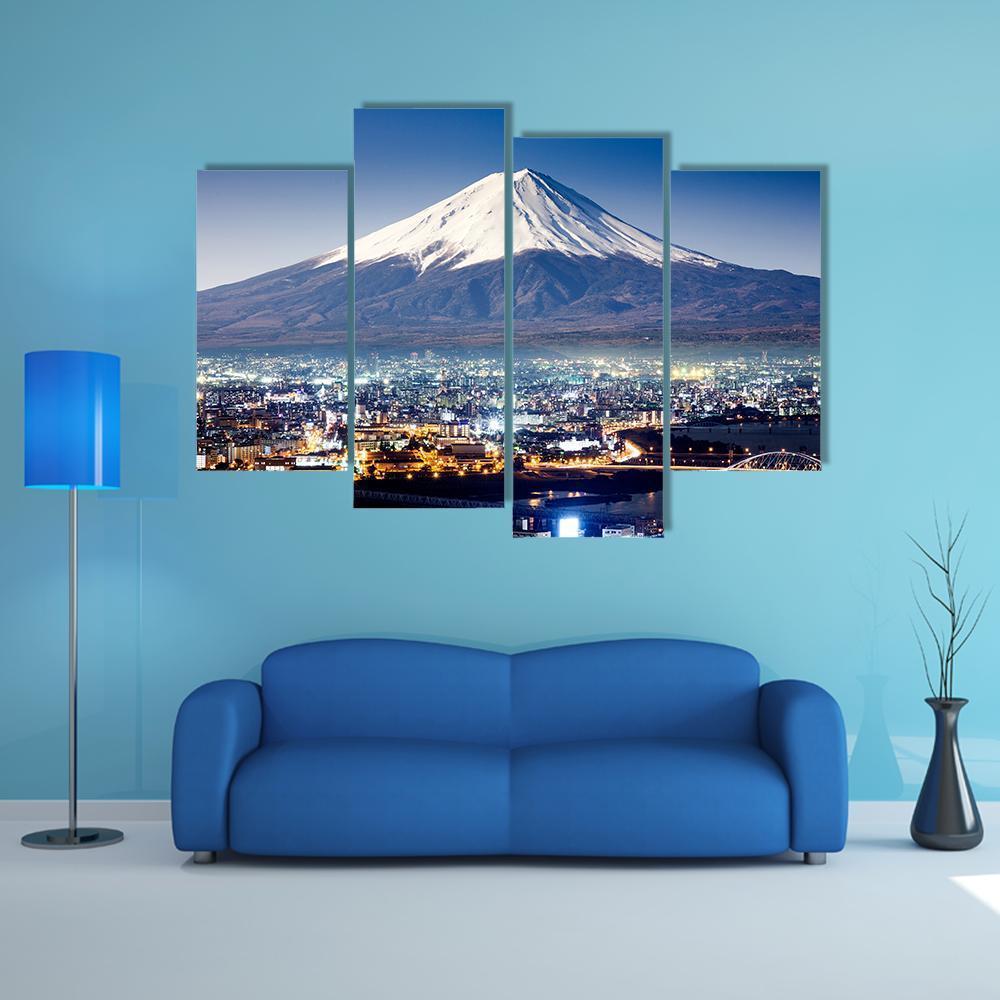
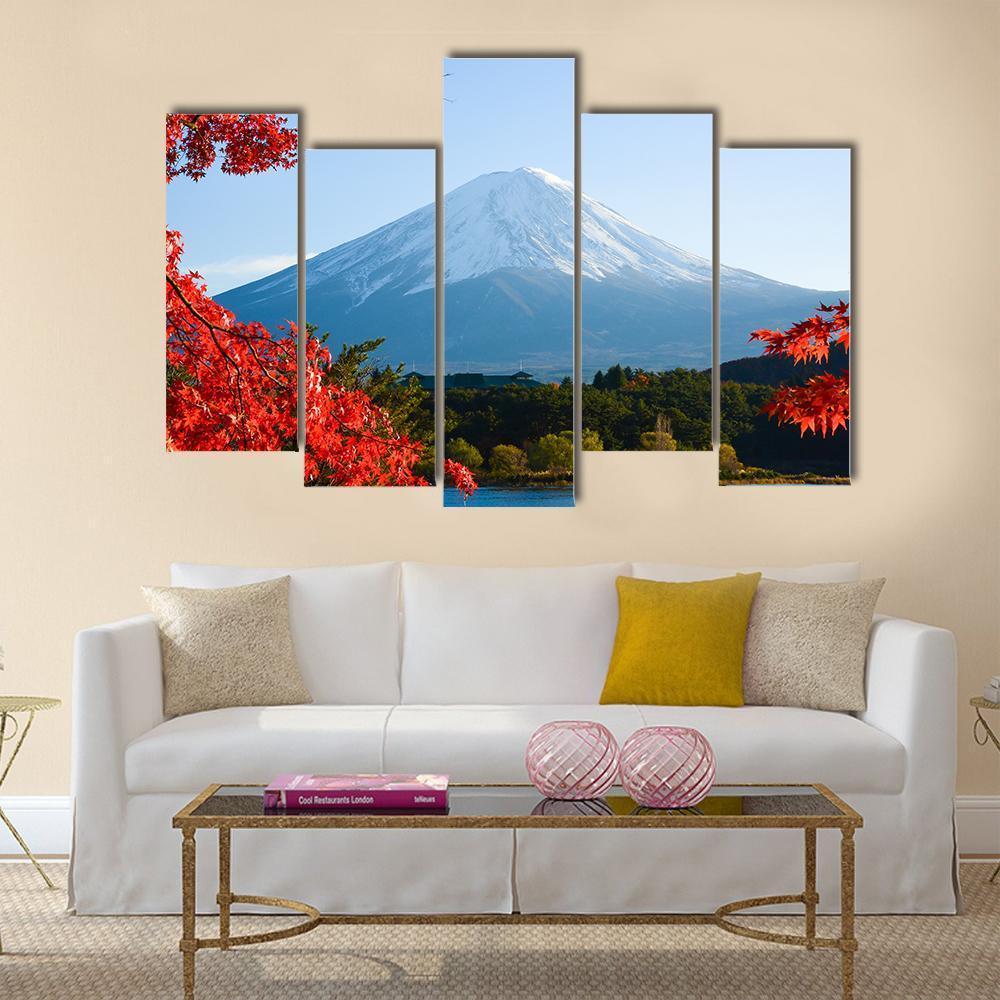
Fuji is in about a quarter of this collection, and it is worth knowing that not all Fuji images are alike.
Fuji with cherry blossom is the spring image, pink foreground against the snow cone, and the most decorative of the set. Fuji reflected in a lake, usually Kawaguchi, Motosu or Shoji, doubles the mountain and produces a symmetrical, restful composition. Fuji in winter strips the palette back to white, grey and blue and is the coolest in temperature. Fuji over tea fields puts a band of green in the foreground and reads warmer.
If you want one Japanese piece and cannot decide, a lake reflection is the safest. The symmetry makes it easy to hang and it carries no strong seasonal color to date the room.
Around 13 percent of the collection is temple and shrine architecture, with castles a further 6 percent.
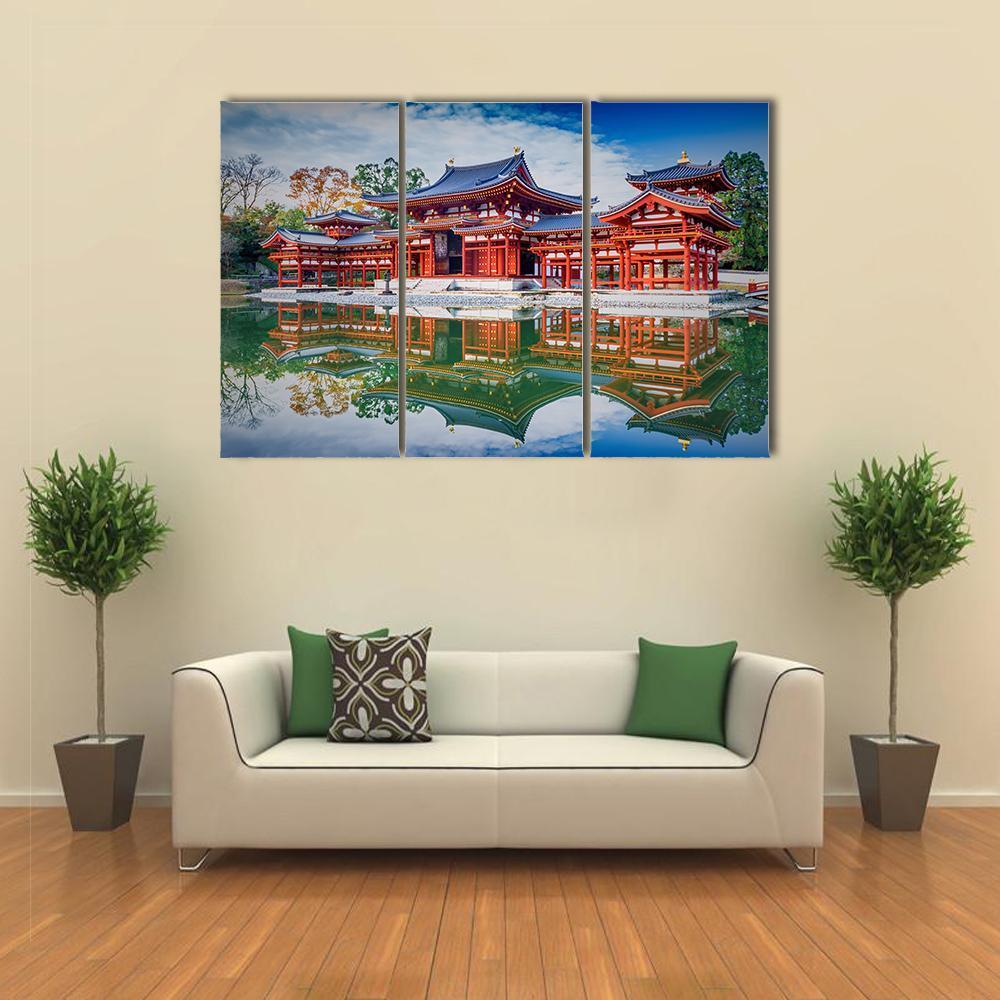
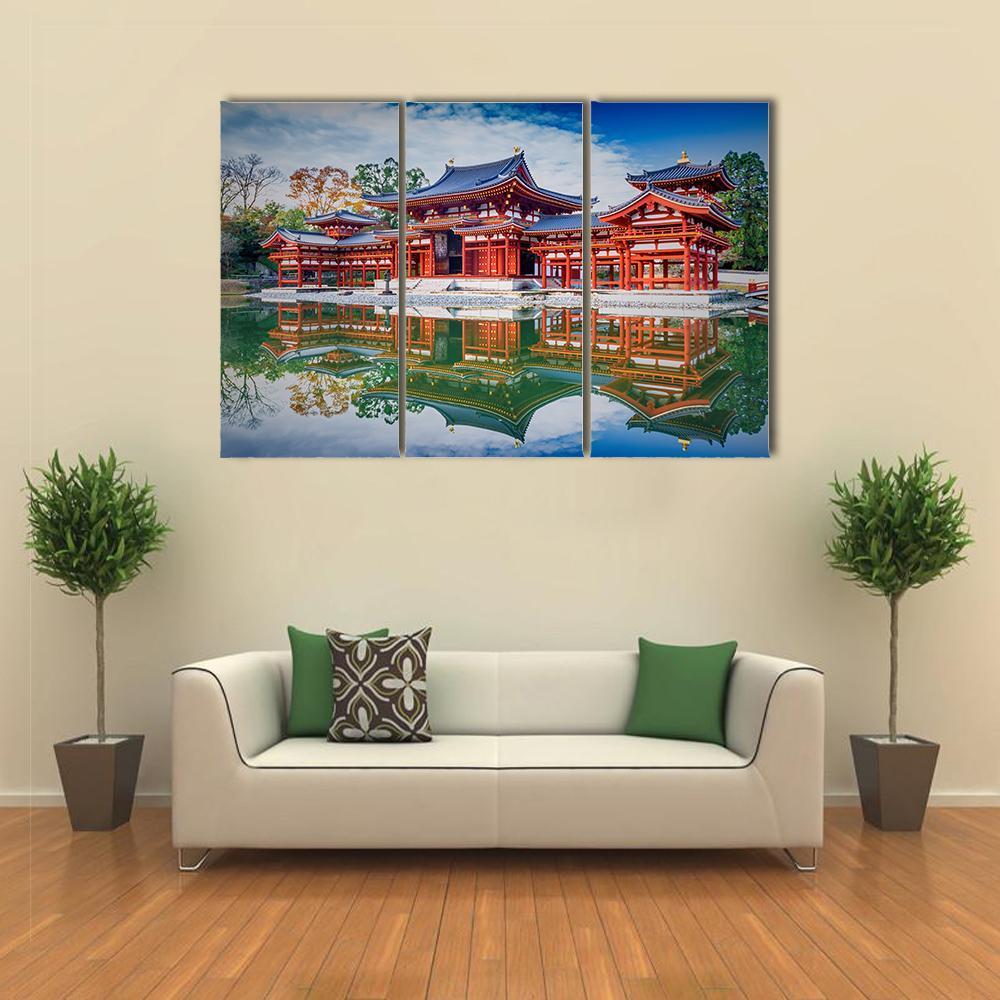
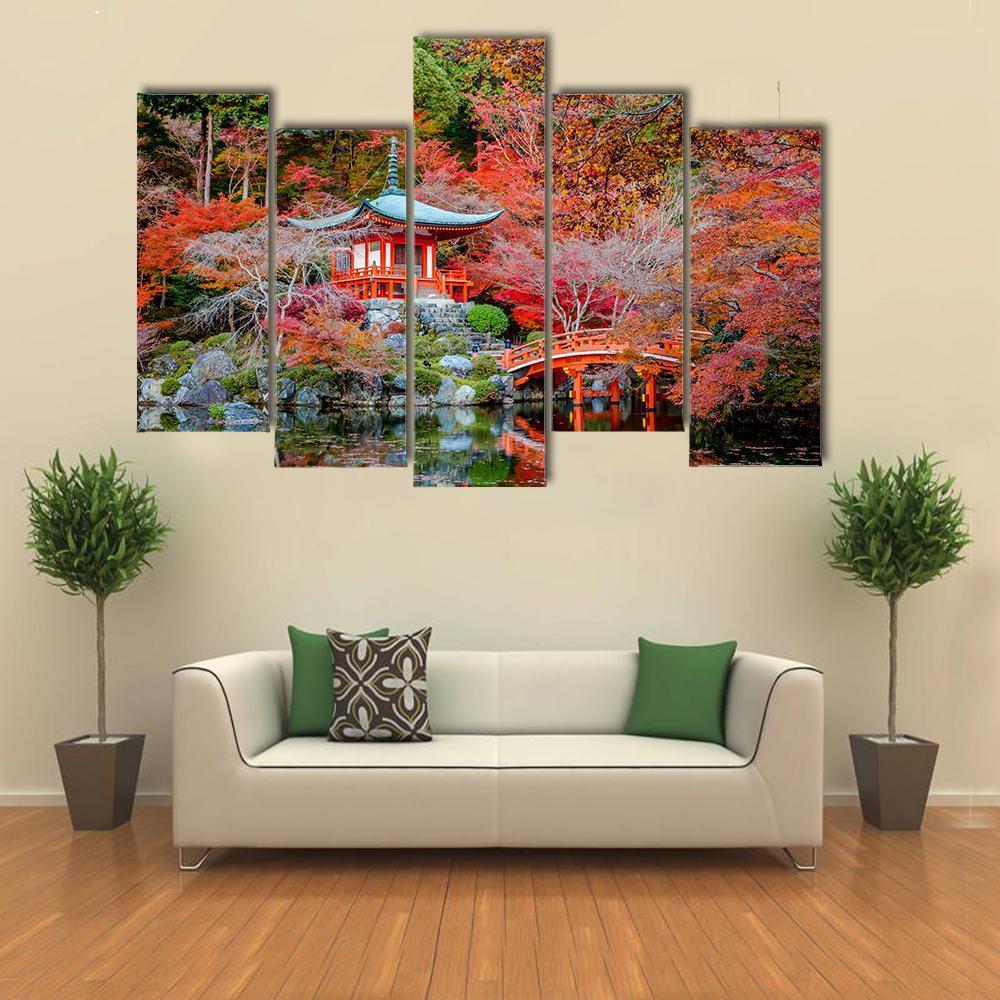
The recurring subjects are Kyoto's Kiyomizu-dera on its wooden stage, Ginkaku-ji and Daigo-ji in autumn, Byodo-in reflected in its pond, the Yasaka Pagoda framed by the sloping street of Sannen-zaka, and Todai-ji in Nara. Among castles, Himeji and Matsumoto appear most, Matsumoto often mirrored in its moat with a red bridge.
These images carry strong architectural line, so they work where you want structure rather than atmosphere. A temple roof against autumn color is one of the few subjects that is simultaneously ornate and calm.
Japanese landscape photography is organized around season more strictly than most, and that is useful when choosing.
Spring is sakura: pink, soft and short-lived. Autumn is momiji, the red and orange foliage season, and it is the larger group here at about 9 percent against 4 percent for cherry blossom. Winter is snow on temple roofs and on Fuji, the quietest palette in the collection. Summer is deep green, bamboo and rice terraces.
Season is the fastest way to match a piece to a room. Autumn and spring images bring warmth into a cool or north-facing room. Winter and bamboo images cool down a room that is already warm.
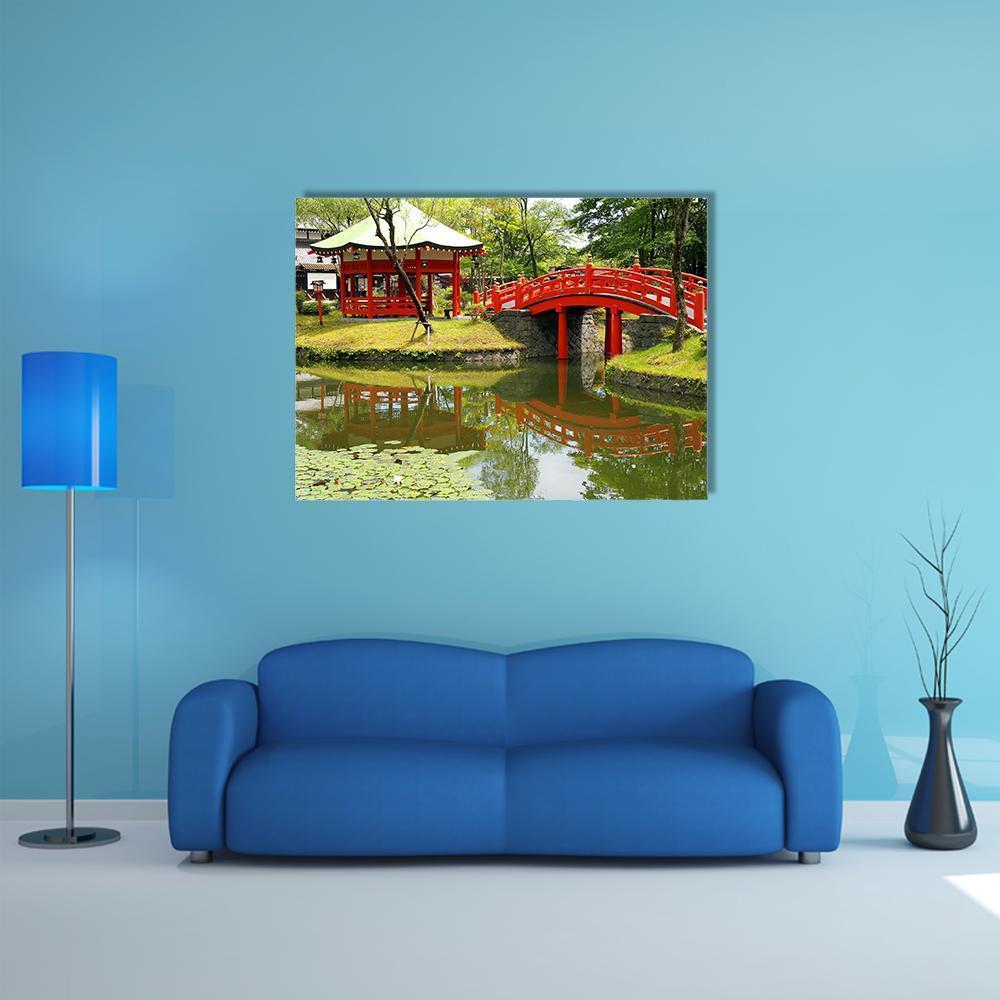
The Arashiyama bamboo grove near Kyoto is the best known of these, and bamboo paths run to about 3 percent of the collection. Gardens are about 7 percent, and they are pond gardens rather than dry ones: arched wooden and red bridges over still water, koi, stone lanterns and pagodas, and temple gardens at Daigo-ji and Rinno-ji.
These are the most restrained images here and the closest to what is now sold as japandi, the pairing of Japanese restraint with Scandinavian simplicity. Green and grey dominate, contrast is low, and there is usually one strong directional line, a path or a stream, running through the frame.
Low contrast is the thing to watch. These pieces are beautiful in person and can disappear on a pale wall, so they want a wall with some depth of color behind them or a position with good light.
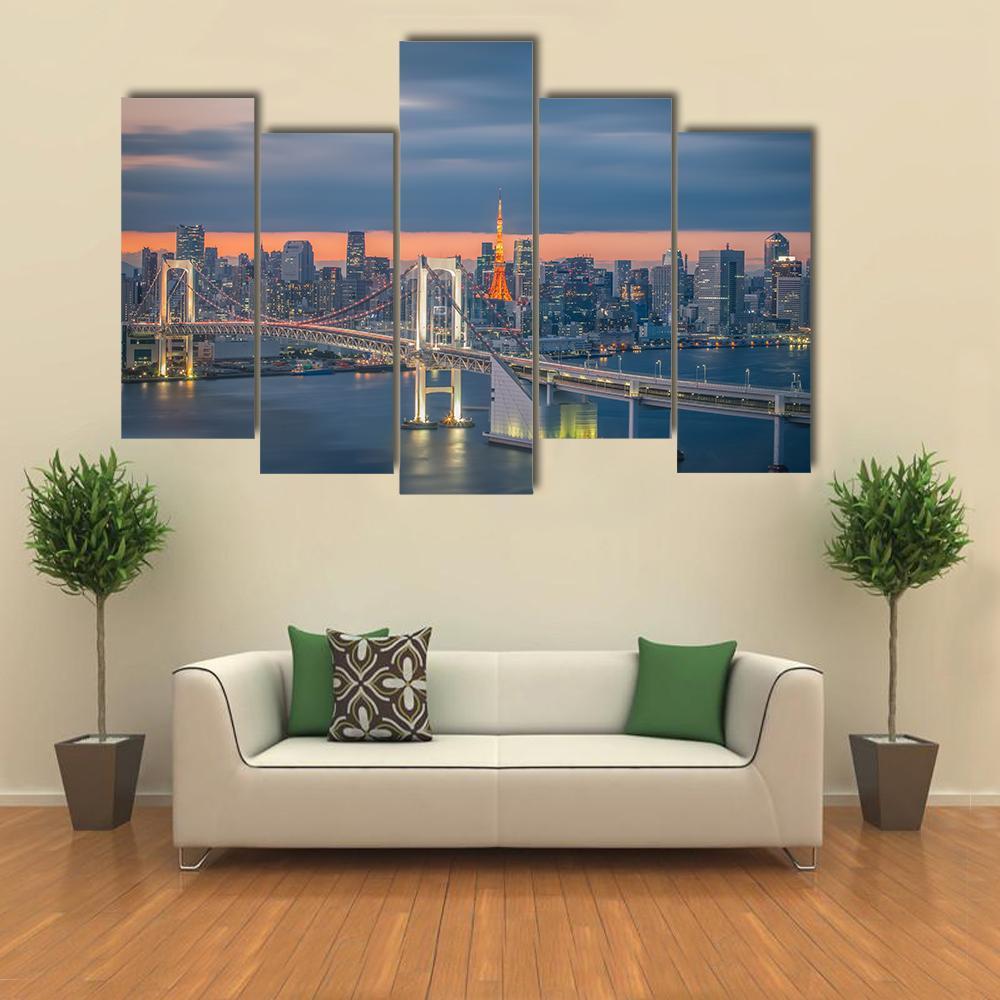
About a fifth of the collection is urban: Tokyo Tower and the Rainbow Bridge, Yokohama's Minato Mirai waterfront, Osaka's port and castle, Kobe's harbor, and skyline views at dusk and after dark.
These are the opposite of the garden images in every way. High contrast, saturated color, and a lot of small bright detail. They suit a room where you want energy, and they hold up on a dark wall in a way the landscape work does not.
Night city images are also the most forgiving of poor lighting, because the picture supplies its own.
The largest single group, at about 27 percent, is water: Lake Kawaguchi and Lake Ashi, the Oirase river in autumn, Ryuzu Falls, the turquoise water at Kamikochi, and the Shinkyo bridge over the river at Nikko.
Water is doing two jobs in Japanese landscape photography. It reflects, which is how the symmetrical Fuji compositions are made, and it carries the eye, which is how the river and waterfall images are structured. Both make for compositions that settle rather than agitate.
Match temperature to the room. Autumn maple and Fuji-with-blossom are warm. Winter, bamboo and night city are cool. A warm image in a north-facing room does more work than any amount of extra size.
Give the quiet pieces contrast. Garden, bamboo and misty lake images are low contrast by nature. On a pale wall they need either a deeper wall color behind them or enough size to hold their own.
One is usually enough. Japanese landscape is composed around empty space. Hanging several close together fills the space the images depend on. If you want a group, keep the spacing generous.
Panoramic suits the lake and skyline subjects. Reflections and city views are horizontal by nature, so a wide format loses nothing and uses the composition properly.
Every piece here is printed to order on museum-quality canvas with archival inks that resist fading, stretched over a solid wooden inner frame, and shipped ready to hang. Shipping within the United States is free, and returns are free for 30 days in the United States, United Kingdom, Australia and Canada.
Japanese wall art covers two distinct things. Traditional Japanese art means the ukiyo-e woodblock tradition of Hokusai and Hiroshige, with flat color and bold outline. Japanese photographic wall art means images of Japan itself: Mount Fuji, temples, torii gates, bamboo groves, autumn maples and city skylines. This collection is the second kind, built from photographs of Japanese subjects.
Mount Fuji is the most recognized and appears in about a quarter of this collection, most often reflected in one of the lakes at its base or paired with cherry blossom. After Fuji come water scenes at about 27 percent, city skylines at about 20 percent, bridges at 16 percent, temples, shrines and pagodas at about 13 percent, and autumn foliage at about 9 percent.
Japandi pairs Japanese restraint with Scandinavian simplicity: muted color, natural materials, uncluttered composition and a lot of empty space. In wall art it means the quieter end of Japanese imagery rather than the bold woodblock end, so bamboo groves, raked gardens, misty lakes and single trees suit it, while high-contrast night city views do not.
The landscape and garden images are tonal and low contrast, which suits bedrooms, hallways and rooms that already carry pattern or color. The night city images are high contrast and saturated, so they suit living rooms, offices and dark walls. Match the temperature of the image to the room: autumn and blossom warm a cool room, bamboo and winter cool a warm one.
Yes, and it is one of the better choices for one. Japanese landscape composition is built around empty space, so a single piece reads as calm rather than crowded. The mistake in a small room is hanging several together, which fills the negative space the composition depends on. One larger piece works better than three small ones.
Guides
Reading that goes with this collection, from our own blog.