

WEEKEND SALE! • EXTRA 10% OFF + FREE SHIPPING DEAL | CODE: WEEKEND10
WEEKEND SALE! • EXTRA 10% OFF + FREE SHIPPING DEAL | CODE: WEEKEND10

Japanese wall art splits into two things that rarely sit on the same wall: traditional style work such as ukiyo-e woodblock and ink painting, and photography of Japan itself. Knowing which one you are after saves a lot of browsing, because the two look and behave completely differently.

Traditional style means ukiyo-e woodblock, sumi-e ink wash, and scroll formats. Flat color, visible outline, deliberate empty space, and often a stylized wave, crane or blossom. This is illustration and printmaking rather than photography, and it reads as graphic art on a wall.
Photography of Japan is the other half: Mount Fuji, temples, torii gates, cherry blossom and Tokyo at night. It behaves like landscape and travel photography, with depth, real light and a horizon.
Tiaracle's Japanese collection is the photography end. If you specifically want a woodblock reproduction, that is a different search. If you want Japan as a place on your wall, this is the right one.

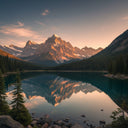
Mount Fuji is the anchor, and it appears in more variations than any other subject here. Mount Fuji with Cherry Blossoms in Spring, Snow-capped Mount Fuji Reflection in Lake Shoji and Mount Fuji Over Green Tea Fields are the same mountain in three completely different palettes: pink, blue white, and green.
Temples and torii carry the strongest color. Fushimi Inari Torii Gate at Dusk and Kiyomizu-dera Temple with Cherry Blossoms bring vermilion, which is the one saturated red in the category and behaves as a genuine accent.
Gardens and bridges are the quietest. Arched Bridge in Japanese Garden and Red Sacred Bridge Shinkyo in Nikko are enclosed compositions with no horizon, so they suit a smaller wall than a Fuji landscape needs.
Tokyo at night is the outlier. Tokyo Tower at Sunset and Rainbow Bridge and Tokyo Tower at Night are city photography, closer in feel to any skyline shot than to the rest of this collection.

Japan photography covers a much wider color range than most single-country collections, which is why choosing on subject alone often disappoints.
Cherry blossom work is pink and pale, and it behaves like a soft neutral. Snow and lake reflection work is blue white and cool. Autumn work, such as Autumn Colors Of Oirase River, is red and gold. Torii and temple work is vermilion. Tokyo night work is black with neon.
Those five palettes do not combine. A vermilion torii gate beside a pale blossom scene reads as two unrelated pictures even though both are unmistakably Japanese. Pick the palette that suits the room, then choose the subject within it.

Japanese composition traditionally treats empty space as a positive element rather than as background, and the photography follows that convention.
A Fuji shot usually places the mountain small in a wide frame, with water or field taking most of the picture. That is deliberate, and it has a practical consequence: these images need room to breathe and they lose their character when cropped tight or hung in a cramped spot.
It also means they suit a plain wall. A busy gallery arrangement fills the space the composition was built to leave empty.

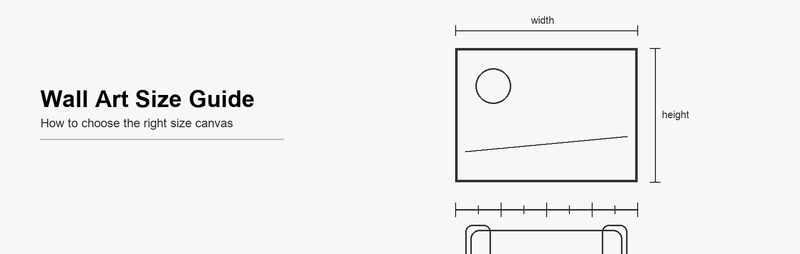
Use the two thirds rule. Artwork above a sofa, bed or console should span roughly two thirds the width of the furniture below it. A standard three seat sofa is about 84 inches wide, so the artwork above it should measure about 56 inches across. Full measurements are in the wall art size guide.
Fuji and lake landscapes reward width, because the empty space is the composition and a narrow crop removes it. Garden and bridge pieces are enclosed and work at smaller sizes.
Every piece in this collection is offered as a single canvas or as a multi-panel set, chosen on the product page. A wide Fuji landscape splits across panels well, with the gaps falling into open water and sky. A torii gate or a temple facade is better as one canvas, since a panel division through a symmetrical structure works against the symmetry.
Start with Japanese Wall Art. For the wider region, Asian Wall Art. For the calm end treated as a whole style, Zen Wall Art. For Fuji alongside other peaks, Mountain Wall Art, and for the emptiness of composition rather than the country, Minimalist Wall Art.
For placing one large landscape above furniture, see wall art above a bed, and for height in a seated room, dining room wall art ideas.
Quick answers
It covers two different things. Traditional style work means ukiyo-e woodblock, sumi-e ink wash and scroll formats, which are illustration and printmaking. Photography of Japan means Mount Fuji, temples, torii gates, blossom and Tokyo, which behaves like landscape photography.
Ukiyo-e, the woodblock print tradition that produced Hokusai's wave, and sumi-e, the ink wash painting tradition. Both use flat tone, visible outline and deliberate empty space, which is what makes them read as graphic rather than photographic.
Five palettes that do not combine: pale pink blossom, cool blue white snow and lake, red and gold autumn, vermilion torii and temple, and black with neon for Tokyo at night. Choose the palette for the room first, then the subject within it.
Because the tradition treats empty space as a positive element rather than as background, and the photography follows that convention. A Fuji shot usually places the mountain small in a wide frame, so the piece needs room and loses character when cropped tight.
Wide. The empty water or field around the mountain is the composition, so a narrow crop removes the thing that makes the picture work. Garden and bridge scenes are enclosed and hold up at smaller sizes.
Shop this guide
Every collection this guide mentions. Each one opens on artwork printed to order on museum-quality canvas.
Pieces shown above
Every piece this guide shows, printed to order on museum-quality canvas.
 Mount Fuji with Cherry Blossoms in Spring Canvas Wall ArtFrom $69.95
 Fushimi Inari Torii Gate at Dusk Canvas Wall ArtFrom $69.95
 Snow-capped Mount Fuji Reflection in Lake Shoji Canvas Wall ArtFrom $69.95
 Arched Bridge in Japanese Garden Canvas Wall ArtFrom $69.95
 Tokyo Tower at Sunset Canvas Wall ArtFrom $69.95
Keep reading
Guides that pick up where this one stops.