

WEDNESDAY SALE! • EXTRA 10% OFF + FREE SHIPPING DEAL | CODE: WEDNESDAY10
WEDNESDAY SALE! • EXTRA 10% OFF + FREE SHIPPING DEAL | CODE: WEDNESDAY10

A gallery wrap is a canvas print stretched over a wooden inner frame where the printed image continues around the sides and is fastened at the back. There is no picture frame and no visible staples on the face or edges, so the piece hangs flush and finished straight out of the box.
The name comes from how galleries hang unframed work. It is now the default way canvas prints are sold online, which means most people buy one without ever being told what it is.
Look at the side of the canvas. That is where the whole difference lives.
On a gallery wrap, the printed image runs over the corner and continues down the side face, typically 1.5 inches deep. The canvas is pulled tight around a wooden stretcher bar and stapled on the reverse, out of sight. From the front you see the image. From an angle you see more of the same image.
The alternative finishes look different at that same edge. A framed canvas has a border of wood or molding around the outside. A museum wrap leaves the sides a solid color, usually white or black, rather than continuing the image. A gallery wrap has neither.

Because a canvas is a physical object standing off the wall, not a flat picture behind glass, and you see its edges from almost everywhere in a room.
Walk past a canvas and the side face is in view for most of that walk. On a gallery wrap it reads as a continuation of the artwork. On a piece with white or unprinted sides it reads as a stripe. Neither is wrong, but only one of them makes the image feel like it occupies real space.
This is also why depth is worth checking before buying. A thin stretcher sits almost flat to the wall and the wrap is barely visible. A deeper one, around 1.5 inches, gives a shadow line and a bit of presence.
Yes, and this is the one genuine trade-off nobody mentions in the product description.
The portion of the image that travels around the sides is no longer on the front face. On a 1.5 inch wrap that is roughly 1.5 inches lost from each edge of the visible picture.
For most artwork this does not matter. Landscapes, abstracts, skies and textures have nothing critical at the very edge. It matters when the composition runs close to the border, or when there is text, a signature, or a face near an edge. If you are ordering a piece where the subject nearly fills the frame, look at the preview and check what the wrap will take.
Good print shops handle this by either mirroring the edge, so the wrapped side is a reflection rather than a crop, or by building extra margin into the source file. Either approach keeps the front intact.

Both are legitimate and they suit different rooms.
Choose a gallery wrap when the room is modern or minimal, the image is dark or high contrast so it defines its own edge, the piece is large, or it is part of a multi-panel set where frames would break the image into boxes.
Choose a framed canvas when the room has a lot of molding, panelling or period detail, the image is pale and would otherwise dissolve into a pale wall, or the piece is joining a gallery wall of mixed artwork where the frame is what makes the group read as intentional.
If you want the full comparison, framed vs unframed canvas covers the decision in detail.

Normally yes, and that is much of the appeal. The canvas arrives stretched on its wooden frame with hanging hardware already fitted, so there is no framing trip, no glass, and nothing to assemble.
It is also lighter than the framed equivalent, which matters on plasterboard and on walls where you are limited in what fixings you can use. Less weight means simpler hanging and less risk on a difficult wall.
Tiaracle's canvases are gallery wrapped: printed to order on museum-quality canvas with archival inks that resist fading, stretched over a solid wooden inner frame, and shipped ready to hang.
Very little is needed, but the exposed surface does change the rules slightly compared with framed art behind glass.
Dust it with a dry microfibre cloth, gently and in one direction. Do not use household cleaning sprays; canvas is fabric with ink on it, not a wipeable surface. Avoid long hours of direct sunlight across the face, which is sensible for any print regardless of ink quality.
Handle it by the wooden frame rather than by pressing on the canvas. The stretched surface has give in it, and pushing on the face from the front is the most common way a canvas ends up with a dent. Our guide to protecting canvas prints covers storage and cleaning in full.
Listings rarely say it outright, so read the images and the specification instead.
Look for an angled product photo. Any seller confident in their wrap shows the piece from the side. If every image is dead-on flat, you cannot see how the edge is finished, and that is worth a question before ordering.
Check the depth figure. A quoted depth of around 1.5 inches, or 0.75 inches on a slim profile, means the canvas is stretched over a bar and there is a side face to finish. No depth figure usually means a rolled canvas or a paper print, which are different products entirely.
Watch the wording. "Gallery wrapped" and "stretched canvas, ready to hang" both indicate the finish described here. "Rolled canvas" means it arrives in a tube and you arrange stretching yourself. "Canvas print" on its own is ambiguous and can mean either.
Check what happens at the edge. Some sellers state whether the wrap is a continuation of the image, a mirrored reflection of it, or a solid color. If the listing says nothing and the artwork is tight to its border, ask.

The wrap does not change the sizing rules, but it does change what you measure.
Product listings usually quote the front face dimensions, which is what you should compare against your wall. The depth is separate and does not affect how much wall the piece covers, only how far it stands off it.
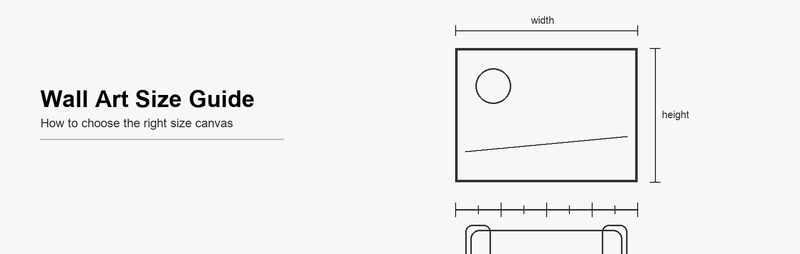
Above furniture, aim for roughly two thirds the width of the piece below and leave 8 to 10 inches of gap. On a bare wall, measure the space and take about 60 to 75 percent of it. The wall art size guide has the full method, and wall art above a sofa covers that specific case.
To browse, see canvas wall art, stretched canvas wall art or large wall art for statement sizes.
Quick answers
It means the printed canvas is stretched over a wooden inner frame with the image continuing around the sides and fastened at the back. There is no picture frame and no staples visible from the front or edges, so the piece is finished on all visible faces and ready to hang as it arrives.
The sides. On a gallery wrap the printed image continues around the edge. On a museum wrap the sides are left a solid color, usually white or black, so the image stops at the front face. Both are stretched the same way and both are unframed.
Some of it moves onto the sides rather than being lost. On a 1.5 inch wrap roughly 1.5 inches from each edge travels around the side face. It rarely matters on landscapes or abstracts, but check the preview if the composition runs close to the border or has text or a face near an edge.
Yes. It arrives stretched on its wooden frame with hanging hardware fitted, so there is no framing, no glass and no assembly. It is also lighter than a framed equivalent, which makes it easier to hang on plasterboard and other awkward walls.
Yes. A floater frame is made for exactly this: it surrounds the stretched canvas with a small visible gap so the wrapped edge still shows. It is a way to add a border later without reprinting, and it keeps the depth that made the canvas look substantial in the first place.
Shop this guide
Every collection this guide mentions. Each one opens on artwork printed to order on museum-quality canvas.
Pieces shown above
Every piece this guide shows, printed to order on museum-quality canvas.
Keep reading
Guides that pick up where this one stops.