


Balance in Art
Balance in art is the even spread of visual weight across a picture, so no side pulls harder than the picture intends. It takes three forms: symmetrical, asymmetrical and radial. On canvas each form suits different pieces, panel layouts and walls. This guide matches each one to real pieces and to the furniture below them.
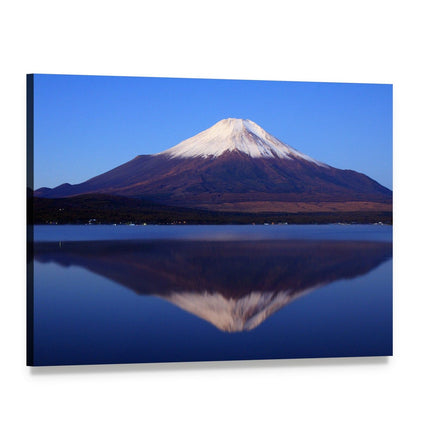
- Symmetrical balance mirrors weight across a center line, as Mount Fuji does over still water, and it suits a canvas centered above a bed or sofa.
- Asymmetrical balance sets a heavy mass on one side against a lighter, brighter area on the other, as the dark Cliffs of Moher do against a lit sea.
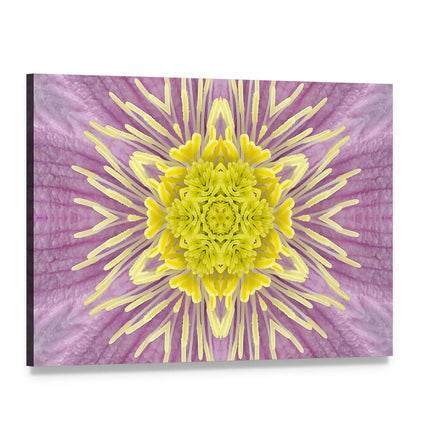
- Radial balance spreads out from one center point, so a mandala wants a 1 Piece canvas and not a layout with a gap through its middle.
- Sets of three or five panels put a panel on the center line, and a set of four puts a gap there.
- Art above furniture spans about two thirds of its width: about 48 inches over a 72 inch sofa, with the bottom edge 6 to 8 inches above the back.
What is balance in art, and what are the three types?
Balance is how visual weight is spread across a picture, and weight is how strongly an area pulls the eye. Nothing in a picture has mass, so balance works on five things: size, color, value, detail and position. A large, dark, saturated, busy area near an edge pulls harder than a small, pale, quiet one near the middle. A picture is balanced when those pulls cancel out. Our guide to the seven principles of art places balance among the others.
| Type | How it works | Reads as | A piece that shows it |
|---|---|---|---|
| Symmetrical | Equal weight either side of a center line, often mirrored | Formal, calm, still | Mount Fuji Reflection in Tranquil Lake |
| Asymmetrical | Unequal elements whose weights cancel out | Alive, natural, informal | Evening at Cliffs of Moher |
| Radial | Elements spread around one center point | Focused, ordered | Mandala Kaleidoscope Flower |
Symmetry and balance are not the same thing. Every symmetrical picture is balanced, but most balanced pictures are not symmetrical. The next three sections take one type each through a piece you can hang.
Which canvases show symmetrical balance?
A symmetrical canvas puts equal weight on both sides of a center line, and still water gives the cleanest version. Mount Fuji Reflection in Tranquil Lake is the clear case, shown here as a 3 Horizontal set. The snow-capped summit sits near the center, and the lake repeats the mountain upside down below the shoreline, so the weight above the line matches the weight below it. In the three panel set the summit and its mirror image sit in the middle panel, and the two gaps fall on sky, slope and water. The set comes in 25 x 16, 37 x 24 and 49 x 32 inches.
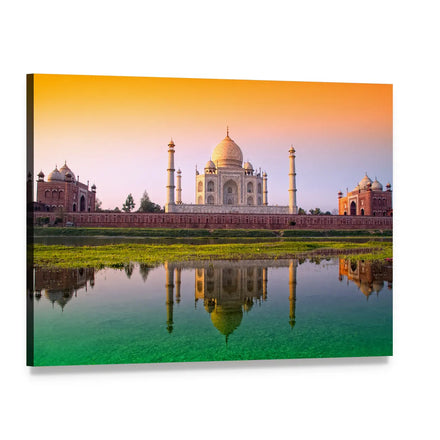
Two more pieces carry the idea into buildings. Taj Mahal with Symmetrical Reflection at Sunset centers the dome between matching minarets and mirrors the scene in water, and Karlsruhe Palace Symmetrical Facade sends a gravel path straight to the middle of a matching palace front. The Lake Wall Art collection holds more mirror-image scenes.
Pro tip: A symmetrical picture forgives no drift. If the canvas hangs a few inches off the middle of the sofa or bed, the eye reads it as a mistake. Find the middle of the furniture first and mark the center of the canvas on the wall to match.

Which canvases show asymmetrical balance?
An asymmetrical canvas sets a heavy mass on one side against a lighter, brighter area on the other, and the eye settles between them. Evening at Cliffs of Moher, shown here, puts a dark wall of cliff at the left. At the right there is a wide sweep of lit sea under a low orange glow. The cliff is the heavier shape and the open water is the larger one, so neither side wins. The Sunset Wall Art collection holds many pieces that pair a dark mass with a glow.
| Piece | Heavy side | Counterweight |
|---|---|---|
| Evening at Cliffs of Moher | Dark cliff wall at the left | Lit sea and a low orange glow at the right |
| Lone Tree Over Snowy Stream at Sunset Vertical | A leaning dark tree and a dark stream curving in from the lower left | A low sun glowing at the right |
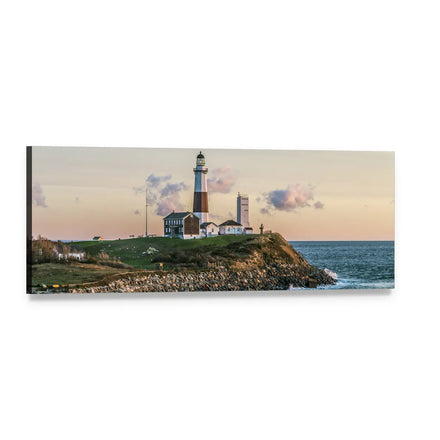
| Montauk Lighthouse at Dusk Panoramic | Headland, lighthouse and buildings at the left and middle | Open sea and sky at the right |
Watch out: Hang an asymmetrical picture by its center, not by its heavy side. The picture already carries the lopsidedness, so the wall should stay even: center the canvas on the furniture and let the image do the offsetting.

Which canvases show radial balance?
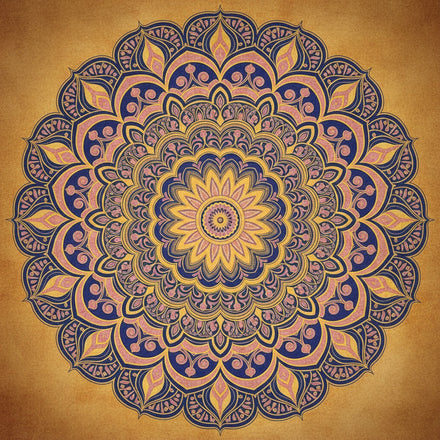
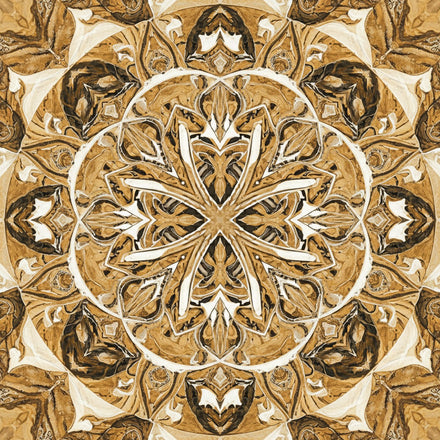
Radial balance spreads everything outward from one center point, so every direction pulls equally and the eye keeps returning to the middle. Mandala Kaleidoscope Flower, shown here, does it with lilac petals and thin yellow stamens that fan out from a yellow-green center. Fractal Mandala does it in rings of gold on black, and Spiritual Mandala does it in white linework on a purple and red gradient. The Mandala Wall Art collection holds more, and our mandala symmetry and placement guide covers where to hang them.
A radial piece wants a 1 Piece canvas, which comes in 24 x 16, 36 x 24 and 48 x 32 inches on this one. The middle is the point of the picture, so a layout that puts a gap through the middle, such as 4 Square on pieces that offer it, cuts the point in half. A 3 Horizontal or 5 Star set keeps the center in the middle panel but cuts the outer rings.
Pro tip: Hang a radial piece where nothing else crowds its center line, such as a clear stretch of wall above a console. It needs room around it to read as a single point.

How does a panel layout carry balance on the wall?
The panel count decides what sits on the center line: a panel for three or five, a gap for four. That makes 3 Horizontal and 5 Star sets symmetrical on the wall, because the middle panel sits on the middle of the furniture. A 4 Square is symmetrical on both axes, so a 2 by 2 grid reads as calm even when the image inside it is busy.
The catch is the picture inside. Taj Mahal with Symmetrical Reflection at Sunset, shown here as a 4 Square set, has a vertical gap that cuts through the dome, so the building is split across two panels. A 3 Horizontal or 5 Star set keeps a central subject inside the middle panel, which is why symmetrical pieces usually suit those layouts better. Our guides to five panel sets and to arranging a 3 piece set cover the spacing, and the Square Wall Art collection holds the 4 Square pieces.
| Layout | On the center line | Balance it gives | Pair it with |
|---|---|---|---|
| 1 Piece | The picture, no gap | Any of the three types | Any piece |
| 3 Horizontal | The middle panel | Symmetrical on the wall | A subject that fits the middle third, such as the Fuji summit |
| 5 Star | The raised middle panel | Symmetrical, with a peak shape | A central subject or a path |
| 4 Square | A vertical and a horizontal gap | Symmetrical on both axes | An even texture, or a subject off center |
Pro tip: Each listing carries a photo of every layout on the real picture. Open the layout you plan to order and look at what the gaps cross before you decide.

How do you balance a canvas with the furniture below it?
Center the canvas on the furniture, not on the wall, and make it about two thirds of the furniture's width. The furniture is the base of the composition and the canvas is the weight above it. Leave 6 to 8 inches between the top of the sofa back or headboard and the bottom edge of the canvas. On a bare wall, keep the center at 57 to 60 inches from the floor. Our guides to art above a sofa and picture hanging height set out both rules.
| Furniture | Art width at two thirds | A piece that fits |
|---|---|---|
| 60 inch queen headboard | About 40 inches | Mount Fuji Reflection in Tranquil Lake, 3 Horizontal, 37 x 24 inches |
| 72 inch sofa | About 48 inches | Evening at Cliffs of Moher, 1 Piece, 48 x 32 inches |
| 76 inch king headboard | About 50 inches | Montauk Lighthouse at Dusk Panoramic, 1 Piece, 48 x 16 inches |
A 49 x 32 inch 3 Horizontal set over a 72 inch sofa. Each panel is 16 inches wide with a half inch gap between them, so the set leaves 11.5 inches of sofa on each side.
| Part of the set | Position from the sofa's left end |
|---|---|
| Left panel | 11.5 to 27.5 inches |
| Middle panel | 28 to 44 inches, centered on the sofa |
| Right panel | 44.5 to 60.5 inches |
Watch out: If the sofa sits off center on the wall, a set centered on the wall puts the middle panel above an end cushion. Center on the furniture and let the empty wall take the difference. Our guide to art above a bed applies the same rule to headboards.

Which kind of balance suits which room?
Choose symmetry where the room should feel settled and asymmetry where it should feel alive. A bed or a sofa is already a long, centered block, so a symmetrical canvas above it doubles the stillness and an asymmetrical one adds movement. A radial piece gives a wall one point to look at.
| Room or wall | Balance | Piece | Layout and size |
|---|---|---|---|
| Above a bed | Symmetrical | Mount Fuji Reflection in Tranquil Lake | 3 Horizontal, 37 x 24 or 49 x 32 inches |
| Above a living room sofa | Asymmetrical | Evening at Cliffs of Moher | 1 Piece, 48 x 32 inches |
| A long wall or console | Asymmetrical, wide | Montauk Lighthouse at Dusk Panoramic | 1 Piece, 60 x 20 inches |
| An entry or hall | Asymmetrical, tall | Lone Tree Over Snowy Stream at Sunset Vertical | 1 Vertical, 18 x 36 or 24 x 48 inches |
| A clear wall above a console | Radial | Mandala Kaleidoscope Flower | 1 Piece, 24 x 16 or 36 x 24 inches |
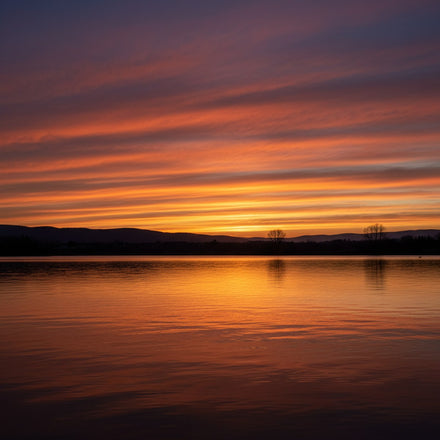
A hall suits the tall version. In Lone Tree Over Snowy Stream at Sunset Vertical, shown here, the dark tree leans to the left, the stream curves in from the lower left, and the low sun glows at the right, so the eye travels the length of the piece. The Vertical Wall Art collection holds more tall pieces, the Panoramic Wall Art collection holds the wide ones, and our hallway and entryway guide covers spacing.

What should you check before you order?
- The type: symmetry for a settled room, asymmetry for a lively one, radial for a single focal point.
- The center line: the subject sits where the layout puts a panel, not a gap.
- The furniture: the canvas is about two thirds of its width and centered on it.
- The height: the bottom edge is 6 to 8 inches above furniture, or the center is 57 to 60 inches from the floor on a bare wall.
- The size: read from the listing's size options, since each layout has its own ladder.
Start with the feeling the wall should have, then pick the balance that gives it.
Lake Wall Art for mirrored scenes, Sunset Wall Art for a heavy mass against a glow, Mandala Wall Art for radial pieces, Panoramic Wall Art for wide walls, Vertical Wall Art for halls and Square Wall Art for four panel grids.
Quick answers
Common Questions
What are the three main types of balance in art?
Symmetrical, asymmetrical and radial. Symmetrical balance mirrors visual weight across a center line and reads as formal and still. Asymmetrical balance uses unequal elements whose weights cancel out, as in a dark cliff against a lit sea. Radial balance arranges everything around one center point, as in a mandala or a flower seen straight on.
What is the difference between symmetrical and asymmetrical balance in art?
Symmetrical balance repeats the same shapes on both sides of a center line, like a mountain and its reflection. Asymmetrical balance uses different shapes whose visual weights still cancel out, like a dark tree on the left and a low sun on the right. Symmetry is calm and predictable, while asymmetry holds the eye longer.
What are examples of balance in art?
A mountain mirrored in still water is symmetrical. A heavy dark cliff on one side answered by a wide lit sea on the other is asymmetrical. A mandala, a flower seen from above and a rose window are radial. On a wall, a canvas centered above a sofa is symmetrical balance applied to the room.
What is the balance principle in art?
It is the rule that visual weight should be distributed so the picture feels resolved and not tipped to one side. Weight comes from size, color, value, detail and position, so a small, bright or dark element far from the center can balance a large one near it. Balance is one of the principles of art.
Is a single canvas or a multi panel set more balanced?
Neither is more balanced by nature. A centered single canvas gives symmetrical balance and reads calm. A set of three or five panels puts a panel on the center line, so it also hangs symmetrically while the image inside can stay asymmetrical. A set of four puts a gap on the center line, so check what the gap crosses.
Shop this guide
The collections in this guide
Every collection this guide mentions. Each one opens on artwork printed to order on museum-quality canvas.



Pieces shown above
The pieces in this guide
Every piece this guide shows, printed to order on museum-quality canvas.
 Mount Fuji Reflection in Tranquil Lake Canvas Wall ArtFrom $69.95
 Evening at Cliffs of Moher Canvas Wall ArtFrom $69.95
 Mandala Kaleidoscope Flower Canvas Wall ArtFrom $69.95
 Taj Mahal with Symmetrical Reflection at Sunset Canvas Wall ArtFrom $69.95
 Montauk Lighthouse at Dusk Panoramic Canvas Wall ArtFrom $98.95

Keep reading
Read next
Guides that pick up where this one stops.