

MONDAY SALE! • EXTRA 10% OFF + FREE SHIPPING DEAL | CODE: MONDAY10
MONDAY SALE! • EXTRA 10% OFF + FREE SHIPPING DEAL | CODE: MONDAY10

Venice wall art is a corridor subject. Every canal view is a channel of water running away between two walls of buildings, which produces strong one point perspective and makes the picture read as depth. That is why these images need width, and why they behave differently from any other city.
Two places answer to the name. Venice, Italy, and Venice Beach in Los Angeles, which has its own boardwalk, its own canals and its own print market. Both rank for the same search.
Everything here is the Italian one: the lagoon city, the Grand Canal, the gondolas. If the goal is skaters, palm trees and the Pacific, that is the California Venice and a different search.
Venice is unusual in that its painted tradition is older and more famous than its photography. Canaletto and the vedute painters of the 18th century made topographical views of these exact canals for travelers to take home, which is the same job a canvas does now.
That history is why results for this subject mix oil paintings, watercolor styles and photographs more than any other city. It is worth deciding which you want, because they behave differently on a wall. A painted Venice reads as decorative and softens a room. A photographic Venice reads as a place, and it carries more contrast.

Seven in ten pieces here are canal and gondola views, and that is not a limitation of the catalogue so much as a description of the city. Venice has almost no roads, so the viewpoint is nearly always along water.
Compositionally that is a gift. A canal narrows as it recedes, the buildings converge, and the eye is pulled down the channel to whatever sits at the end. It is the same device a path gives a forest picture, built into the subject.
Gondolas Docked on Grand Canal is the wide version, where the water opens out. Picturesque Venice Canal with Vintage Style is the narrow version, a side canal closing in on both sides.

Because the composition runs away from the viewer rather than upward, Venice suits horizontal and panoramic formats and resists vertical ones. Panoramic pieces outnumber vertical ones here by more than three to one, which reflects how the subject actually photographs.
A panoramic canvas at up to 60 by 20 inches on a single piece holds a Grand Canal view properly, because the recession has room to run. Cropped tall, the same scene loses the buildings on either side and the perspective collapses. If a tall narrow wall needs filling, this is the wrong subject and vertical wall art for tall walls covers the ones that suit it.

About a third of these pieces are sunset or dusk, and they are the warm version: apricot sky, gold on the water, dark gondola silhouettes. Sunset Gondolas on Venetian Canals and Sunrise Over Venice Canals are that treatment, and they suit warm rooms with wood and brass.
Daylight Venice is the cooler alternative, dominated by the green of the canal water and the ochre and terracotta of the buildings. It is busier and more detailed, and it sits better in a room that is already neutral.
The same warm and cool decision governs other Mediterranean subjects, and it is set out at more length in greece wall art, blue domes or gold sunsets.

St Mark's square and the Doge's Palace are the other recognizable subjects, and Burano is the outlier worth knowing about. Burano is the lagoon island where the houses are painted in saturated blocks of red, blue, yellow and green.
A Burano picture is barely recognizable as the same city. It is the one genuinely colorful option in this subject, and it belongs in a room that can take strong color rather than one being kept quiet.

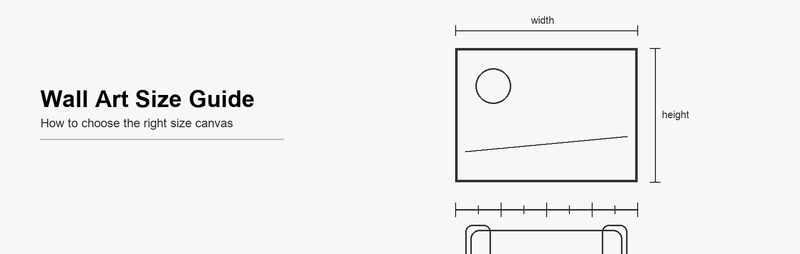
Over a sofa or sideboard, span roughly two thirds the width of the furniture and leave a six to eight inch gap. On a bare wall, center at 57 to 60 inches from the floor. Full measurements are in the wall art size guide.
Because the subject wants width, this is a good candidate for scaling up rather than across: one wide canvas or a multi panel set spanning the wall, rather than a grid of small frames that would cut the perspective into pieces.
Venice sits inside Italy Wall Art, alongside Rome, Tuscany and the Amalfi coast. For the format the subject needs, Panoramic Wall Art, and for a canal view scaled to a large wall, Large Wall Art.
For the sunset treatment, Sunset Wall Art. For the same approach to other skylines, City Wall Art, and the warm and cool question in another European city is covered in paris wall art, golden hour or black and white.
Every piece is printed to order on museum-quality canvas with archival inks that resist fading, stretched over a solid wooden inner frame and delivered ready to hang.
Quick answers
Both rank for the term. Venice, Italy is the lagoon city of canals and gondolas. Venice Beach is a Los Angeles neighborhood with a boardwalk and its own canals. Everything in this collection is the Italian city.
Horizontal, and often panoramic. A canal view is built on perspective running away from the viewer, so it needs the buildings on both sides to work. Cropped tall, the recession collapses and the picture loses the thing that made it.
Because the painted tradition came first. Canaletto and the 18th century vedute painters made topographical views of these canals for travelers, and that association stuck. A painted Venice reads decorative and soft; a photographic one reads as a place and carries more contrast.
Burano, the lagoon island where the houses are painted in saturated blocks of red, blue, yellow and green. It looks almost nothing like the rest of the city and suits a room that can take strong color rather than one being kept neutral.
Span roughly two thirds the width of the sofa below, with a six to eight inch gap above it. Since the subject wants width, a single panoramic canvas up to 60 by 20 inches or a multi panel set works better than several small frames, which cut the perspective apart.
Shop this guide
Every collection this guide mentions. Each one opens on artwork printed to order on museum-quality canvas.
Pieces shown above
Every piece this guide shows, printed to order on museum-quality canvas.
 Gondolas Docked on Grand Canal Canvas Wall ArtFrom $69.95
 Picturesque Venice Canal with Vintage Style Canvas Wall ArtFrom $69.95
 Sunset Gondolas on Venetian Canals Canvas Wall ArtFrom $69.95
 Sunrise Over Venice Canals Canvas Wall ArtFrom $69.95
 Gondola on Venice Canal at Sunset Canvas Wall ArtFrom $69.95
Keep reading
Guides that pick up where this one stops.