


Emphasis in Art: How a Focal Point Works
Emphasis in art is how a picture makes one part claim the eye first, and that part is the focal point. Artists build it with contrast, isolation, placement, scale, converging lines or sharp focus. On a wall the same rule applies twice, because a picture needs one focal point and so does the room around it.
This guide defines both terms, sorts the six methods with a canvas from the large canvas wall art range for each, and then asks what a painting class never does: what makes a single canvas the focal point of a wall.
What a focal point is, and what emphasis adds
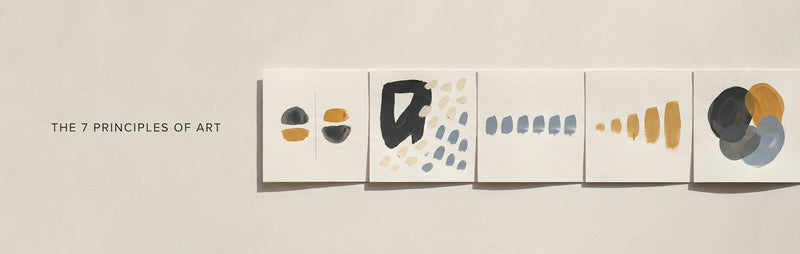
The focal point is the part of a picture that draws the eye before anything else does. Teachers also call it the center of interest. Emphasis is the principle behind it, one of the seven principles of art alongside balance, contrast, movement, rhythm, proportion and unity, all sorted in the 7 principles of art.
Emphasis has a second half, called subordination. Everything that is not the focal point is made quieter: softer color, less detail, blurred edges. One dominant focal point is the norm, and a minor second one may support it. The exception is the all-over composition, such as Jackson Pollock's drip paintings of the late 1940s, which gives every part equal weight on purpose so the eye never settles.
Six ways to make a focal point
| Method | How it works | What it looks like on a canvas |
|---|---|---|
| Contrast | The eye goes to the biggest difference in light, color or texture | One pink butterfly among blue ones; one lit bulb among dark ones |
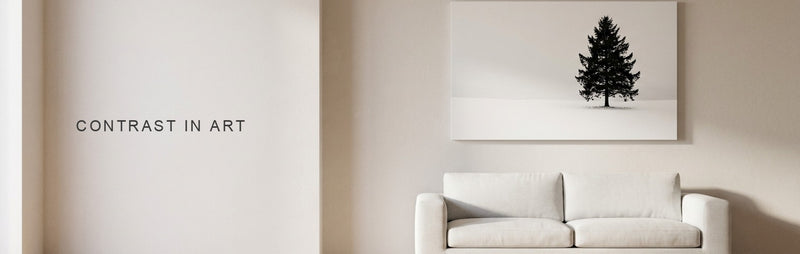
| Isolation | One subject alone in open space, with nothing to compete | A lone tree on a field; a single boat on still water |
| Placement | A subject on a third line pulls harder than one lost in the middle | A tree on the right third of a wide field |
| Scale | A tiny figure in a vast setting becomes the measure of the scene | A small figure at the top of red steps on an empty cream ground |
| Leading lines | Roads, paths and rivers run toward the subject | A red path curling across a pale ground to a red peak |
| Sharp focus | The sharp area wins against a blurred ground | A red tulip crisp against a soft green background |
The methods stack. The strongest focal points use two or three at once.

Isolation: one subject alone in open space
Isolation is easy to find in the range. Titles that open with Lone, Lonely, Solitary or Single make up a large group, and the great majority are one subject set in open space: a tree on a hill, a boat on still water, a figure on a dune, a bench beside a lake.
It works because of how a landscape is built. A horizon is a long horizontal line, and a lone tree is the one vertical that interrupts it, so the eye goes where the pattern breaks. A single boat on calm water works the same way: its reflection doubles the weight of the subject while the empty water does the subordinating. The empty part is the method, as argued in negative space in art. The minimalist wall art range is built on the same idea.

Contrast: the one thing that is different
Contrast puts the focal point on whatever differs most from its surroundings. A single pink butterfly on a field of blue ones is the only warm color in the frame, so the eye lands on it at once. A single lit bulb among unlit ones does the same with light instead of hue, and it is a plain case of value contrast: one bright shape on a dark ground.
The rule that matters is "one". If two things differ equally from the rest, the picture has two focal points and the eye shuttles between them. Value, color and texture contrast are laid out in full in contrast in art.

Leading lines and scale point the eye home
A line that runs toward a subject carries the eye along it. In the red path piece, a single red ribbon curls across a cream ground and ends at a red mountain, so the line, the color and the subject agree. A road through a mountain pass works more quietly, the bend in the tarmac being the route the eye takes in.
Scale does the opposite job. A small figure at the top of a flight of red steps, on a cream field with nothing else in it, is a tiny part of the picture and still the first thing seen, because it is the only human-sized object and the only thing that gives the emptiness a measure.

Sharp focus: the photographer's version
The term has a literal side in photography. The focal point is the subject held in sharp focus, and a wide aperture blurs everything in front of it and behind it. The sharp subject separates from its ground without any change of color. A single red tulip, crisp against a soft green blur, uses both focus and color at once. The logic matches the painting version: whatever is sharpest is seen first.
Four paintings, four methods
The same methods run through paintings most people have seen. Vermeer's Girl with a Pearl Earring, painted around 1665, sets a lit face and one bright pearl against a plain dark ground, which is contrast and isolation together. Edvard Munch's The Scream, from 1893, bends the bridge railing and the bands of sky so they converge on the figure's head, which is leading lines. Hokusai's The Great Wave off Kanagawa, from about 1831, curls the wave around a small, distant Mount Fuji, which is framing and scale. Edward Hopper's Nighthawks, from 1942, lights one diner against an empty dark street, which is value contrast again.

A canvas is the focal point of a wall, and a wall needs only one
Designers use the term for rooms as well as pictures. A room's focal point is the feature the eye goes to first on walking in: a fireplace, a bed, a window with a view. A wall with no built-in feature, such as the one behind a sofa, gets its focal point from the art, and the simplest way to make one is a single large canvas with a single clear subject.
Size is what turns a picture into a focal point. A single horizontal canvas is offered at 24 x 16, 36 x 24 and 48 x 32 inches, and 48 inches is two thirds of a 72 inch sofa, the usual target set out in horizontal wall art and the two thirds rule. A long low wall, above a bed or a console, suits a panoramic wall art single at 36 x 12, 48 x 16 or 60 x 20 inches, which gives a lone tree or a boat the length it needs. A narrow wall or stairwell suits a single vertical, from 12 x 24 inches up to 30 x 60 on most pieces. Hang any of them with the center of the picture at 57 to 60 inches from the floor, as picture hanging height explains.
Keep to one focal point per wall. A large canvas beside a busy gallery wall gives the eye two stops with equal rank, and neither wins. Splitting a picture into panels adds seams that cut through the image, so a single subject usually suits one canvas, and composition in art covers where the seams of each layout fall.

How to test a picture before you hang it
Squint. Half-closing the eyes strips out detail and leaves only large shapes and values, and the one that survives is the focal point. If nothing survives, the picture reads as wallpaper. If two things survive at equal strength, it will read as an argument. A single lit bulb on a dark ground passes the test in one glance, and a busy abstract needs a longer look.
Then view it small, on a phone, since a focal point that works at thumbnail size works across a room. Check where the subject sits against the grid in the rule of thirds in art, because an off center subject moves the eye and a centered one holds it. Last, picture the size it will be on your wall. A tree that is a quiet accent at 24 x 16 inches dominates the wall at 48 x 32.
Quick answers
Common Questions
What is a focal point example?
A lone tree on an open field is the plainest example: it is the one vertical in a horizontal landscape, so the eye goes there first. Others are one pink butterfly among blue ones, one lit bulb among dark ones, and the bright diner in Edward Hopper's Nighthawks. In each, one element is different from everything around it.
What are examples of emphasis in art?
Vermeer's Girl with a Pearl Earring sets a lit face and one bright pearl against a dark ground. Munch's The Scream bends the railing and the sky toward the figure's head. Hopper's Nighthawks lights one diner on an empty street. In a photograph, one pink butterfly among blue ones does the same job.
What is the difference between emphasis and a focal point in art?
Emphasis is the principle and the focal point is the result. Emphasis is what the artist does, through contrast, isolation, placement, scale, leading lines or sharp focus. The focal point is the place on the canvas where the eye lands because of it. A picture can use emphasis without a single exact focal point, as an all-over composition does.
How do you create a focal point in a painting or photograph?
Make one element different from the rest and quiet everything else. The usual tools are contrast of light or color, isolating a subject in open space, placing it on a third line, making it small against a vast setting, running lines toward it, and keeping it sharp against a blurred ground. Two or three of these together are stronger than one.
What size canvas works as the focal point of a wall?
About two thirds the width of the furniture beneath it. Above a 72 inch sofa that is a 48 x 32 inch single canvas, and a long low wall suits a 60 x 20 inch panoramic. Hang it with its center 57 to 60 inches from the floor and keep the rest of the wall quiet so the canvas is the only strong object.
Shop this guide
The collections in this guide
Every collection this guide mentions. Each one opens on artwork printed to order on museum-quality canvas.


Pieces shown above
The pieces in this guide
Every piece this guide shows, printed to order on museum-quality canvas.
 Lone Tree at Sunset Canvas Wall ArtFrom $69.95
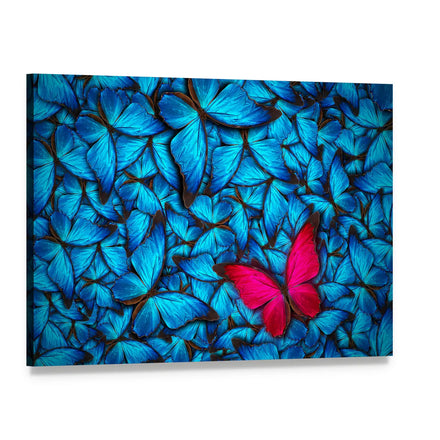 Single Pink Butterfly Among Blue Butterflies Canvas Wall ArtFrom $69.95
 Solitary Figure on Red Path to Geometric Mountain Canvas Wall ArtFrom $69.95
 Single Red Tulip Emerging from Soil Canvas Wall ArtFrom $69.95
 Solitary Tree at Golden Hour Panoramic Canvas Wall ArtFrom $98.95


Keep reading
Read next
Guides that pick up where this one stops.